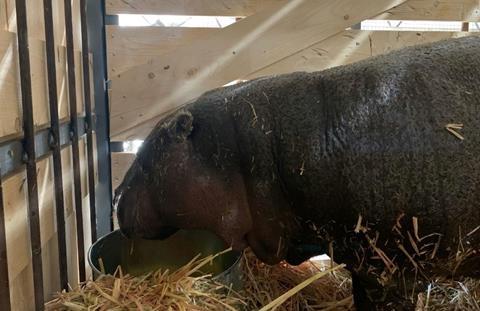
Animal air transport demand is growing and airlines are investing to make sure they can fulfil their responsibilities to relocate animals to natural habitats, specialist facilities and zoos.
Welfare is paramount when it comes to transporting animals by air. And as more and more animals find themselves moving this way, the strain on carriers and their logistics partners to match up to the demands of these animals has only intensified.
Speaking to that increase, IATA reported that in the five years to the end of 2024 the number of animals transported leapt up 11%, surpassing the 200,000 mark annually.
Much of this increase has been driven by a heightened focus on conservation, with airlines bearing responsibility for returning animals to either their natural habitats or to specialist facilities and zoos to ensure species’ survival.
Lufthansa Cargo is one of a number of carriers to have made a name for itself in the animal transport sphere. That name has left it responsible for some 10% of total animal movements, with a spokesperson telling Air Cargo News (ACN) that they are expecting to transport around 3,500 horses, 14,000 pets, and 80 zoo animals, together with large numbers of aquatic life over the 12 months of 2025.
Noting that the carrier has seen “pretty much stable demand in recent year,” the spokesperson adds that Lufthansa too is seeing growth regions.
“As trade lanes and economic developments shift these days, we see a growing demand from South America, for which we offer our customers reliable transport solutions,” they tell ACN.
“Lufthansa Cargo offers customers a broad global network with over 350 destinations in 100 countries. Transport routes for animals are almost as wide ranging as our overall network.”
Strong growth ahead
A report from Technavio suggests the animal transport market will experience a compound annual growth rate of more than 5% over the five years to 2029, increasing by some $638m in value.
Much of this growth, it puts down to the increasing demand for meat. Of course, not all of this increase will be catered to by airlines. But, over the past decade one species in particular has increased its air miles, with more and more horses being moved by air over road.
This shift followed findings from a 2013 report that the capacity of aircraft to cover greater distances in faster time had a marked, positive impact on the mental and physical well-being of horses.
One source tells ACN that this shift has proved a healthy revenue generator for those carriers willing and able to facilitate equine movements.

Tapping into that trade is Maastricht Aachen Airport (MST), which announced the signing of an agreement with ECS Livestock at June's Air Cargo Europe event in Munich.
Under the partnership, MST will become the preferred gateway for Dutch equine transport. This was in large part thanks to its AnimalPort Netherlands airside facility, boasting accommodation for up to 32 horses and featuring flexible floor system alongside a dressing room, hygiene lock, and washing stations.
MST’s head of commercial development Dean Boljuncic says that the facility served as “an international mark of quality for our airport”.
“If you can handle live animals safely and efficiently, it proves the high standards of your cargo operations,” Boljuncic continues. “Alongside pharma and chilled goods, live animals are delicate cargo that require careful handling. Thanks to the extensive experience and expertise of our cargo team, this is something we can deliver at MST.
"A cargo aircraft rarely transports only horses. Airlines often combine horse shipments with other freight, and this will create new routes from MST, which will benefit the local cargo community. The more routes we have, the more opportunities to ship our clients’ cargo worldwide via MST and several airlines have already expressed interest in using MST for horse transport.”
That deal will have been all the more welcome for the Dutch gateway given that just a few weeks earlier its compatriot, Schiphol in Amsterdam, announced that it would be opening a new dedicated animal handling centre.
Forming part of the dnata Cargo City Amsterdam complex, the purpose-built, temperature-controlled 2,380 sq m facility, due to open later this summer will offer space for more than double that of MST’s, at 70.
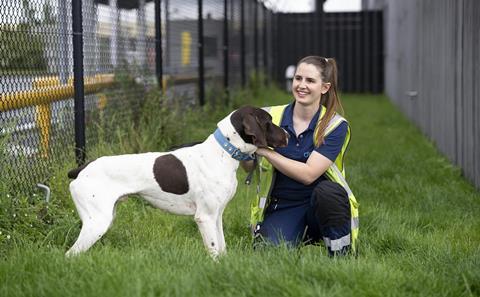
Alongside its IATA CEIV (Centre of Excellence for Independent Validators) Live Animal Certification, the team at the dnata complex have also been fully trained in the UN body’s Live Animals Regulations (LAR).
Digital development crucial
LAR was itself expanded in April through the launch of LAR Verify, a digital portal to improve the welfare and safe transport of live animals by air, which allows carriers, forwarders and shippers to access accurate operator and destination-specific LAR requirements, which it says will streamline planning, booking, acceptance and handling.
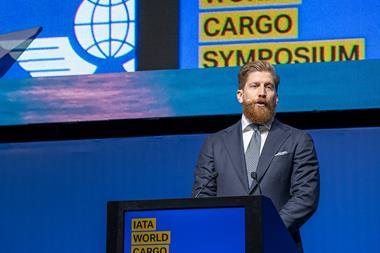
IATA’s global head of cargo Brendan Sullivan says LAR Verify’s launch was precipitated by the continuing growth in animal transport volumes.
“To manage this opportunity safely and efficiently, a single digital portal that provides access to relevant LAR regulations and facilitates data sharing is mission critical,” Sullivan continues.
“As envisioned by IATA’s ONE Record initiative, the release of LAR Verify is a key milestone towards achieving a single source of truth for live animal shipments.”
The move by IATA to digitalise processes reflects the Animal Transport Association’s (ATA) belief that “the future of live animal transport lies in digitalisation”.
But speaking at its annual conference in Doha earlier this year, ATA president Sean Harding said that the live animal transport sector found itself at an inflection point, urging that with evermore animals being moved – not only by air but also by rail, road, and sea – there needed to be greater efforts to harmonise regulations and ensure that the quality work being conducted by some logistics players was mandatory across the supply chain.
Harding’s calls have, to some extent been heeded in Europe, with the European Union approving its newly launched Animal Transport Regulation in March. And speaking to that desire to see digitalisation integrated into all animal movements, the EU regulation required real-time location tracking and set time limits for transport.
Regulation backlash
Although not everyone is on board. Eurogroup For Animals warned that the newly approved Animal Transport Regulation had included some significant watering down of the initial policies, not least of which the removal of a provision to limit the longest an animal can be in transit to 21 hours – for airlines this likely would have proved a strong revenue generator as evermore customers looked to the skies to get their animals where they needed to be.
Farm animals slaughter & transport programme officer for the group Susanna Blattner describes the amendments as “deeply worrying”, noting that they “ignore scientific evidence, dismiss public concern, and would leave countless animals to suffer in silence”.
Blattner adds: “This revision is a once-in-a-generation opportunity to finally align transport rules with animal welfare needs. It must stay true to its purpose: to protect animal welfare. Anything less would be a betrayal of both science and public trust.”
While policymakers and regulators continue to work out how to meet the demands of various interested parties, the safe transport of animals appears largely left in the hands of carriers and the wider logistics community.
Fortunately, it seems that there is a strong contingent that are cognisant of the need to meet the demands of animals if they are to see any repeat business. Indeed, sources tell ACN that in many cases, while passenger demand may often outrank the demands of most airlines’ cargo business, when it comes to animal cargo, the animals travel better than the passengers up top – “this even includes horses going by private plane”.
Reemphasising the paramount importance of animal welfare for carriers, Lufthansa Cargo’s spokesperson tells ACN that the well-being of all the animals it flies has been the airline’s “utmost priority” since it began offering the service.
“Therefore, we have specially trained staff on site at our Frankfurt Animal Lounge, one of the world’s most modern animal stations,” they continue. “It was designed to meet all individual requirements in the transport of different animal kinds as well as being compliant with all requirements by authorities.
"Export, import and transit areas are clearly separated from each other by built-in partitions, thus avoiding any contact between animals being exported and those being imported. Individual areas can be further sub-divided into different sections to ensure that animals can be shielded from the sight and sound of others.
"The examination area can be divided into two sections, enabling the complete isolation of one section, whilst work continues undisturbed in the other. Loading area protected against weather.
"Overall, it offers 42 large animal stalls plus further mobile stalls with a floor space of up to 28 sq m, 39 small animal boxes, three separate rest areas with multiple boxes for cats, special aviaries, 18 individual, temperature-adjustable climatic chambers and some stalls can even be divided flexibly if required, e.g. for mares with foal.”
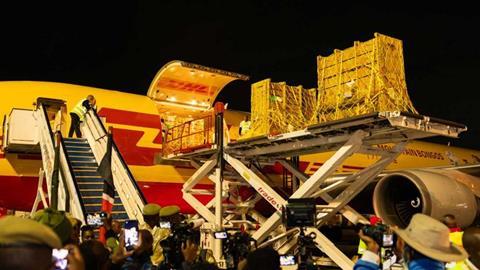
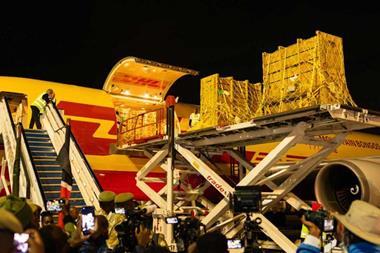
Those efforts are worth it because when it goes right, customers express nothing but gratitude. Referencing transport of some 17 critically endangered mountain bongo antelopes from Florida to Kenya carried out by DHL Express on behalf of animal welfare charity Tusk, the charity’s founder and president Charlie Mayhew said "we are hugely grateful to our global partner DHL Express for their generous support in transporting the bongos – yet another key milestone in the partnership between our organisations".
Mayhew added: “DHL’s dedication to environmental sustainability, and its role as a responsible corporate partner in supporting Tusk’s mission to protect Africa’s wildlife and natural habitat, is invaluable.”