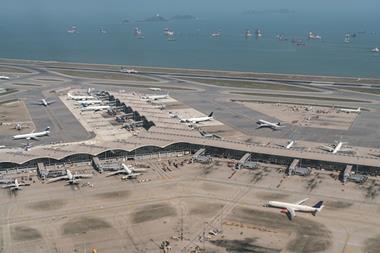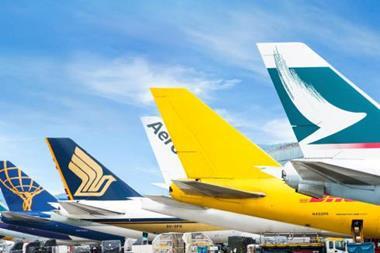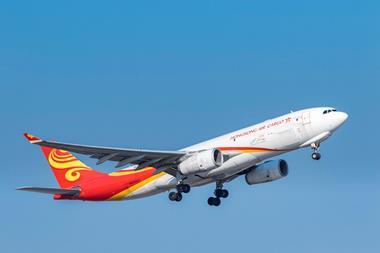
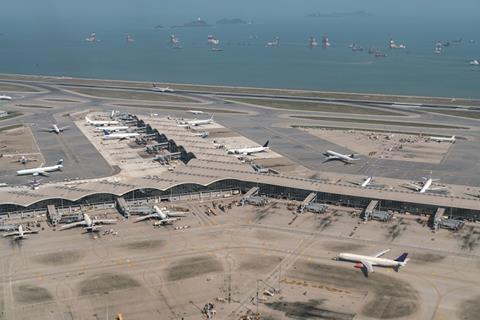
Hong Kong International (HKIA) showed why it is the world’s busiest cargo airport and, despite the challenges, the work it is putting in to stay top during the TIACA Executive Summit 2025.
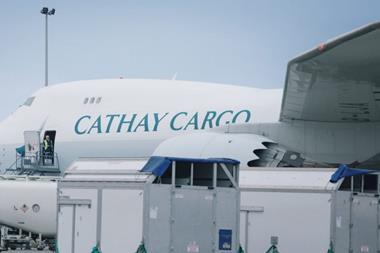
Both the industry and the government are involved heavily in the multi-faceted approach. Leading the way is home carrier Cathay Pacific, which is planning a huge fleet expansion.
Included in the more than 100 state-of-the-art planes it has on order are six new generation A350 freighters, although it has the right to acquire 20, Tom Owen, director Cargo told the Summit.
These are 25% more efficient per payload tonne compared with existing models, he added.
“These planes are super efficient and are going to make up the bulk of our fleet over the years ahead,” Owen said.
That, along with its own dedicated air cargo terminal at Hong Kong International Airport, gives the airline considerable capacity to serve its existing freight-only destinations and any more it can open up.
Chek Lap Kok (HKIA’s full name) also brings two other advantages, as Cissy Chan, executive director, commercial for the facility, pointed out.
One is that it moved to a three-runway operation at the end of last year, giving it the potential to move 10m tons annually, she said.
The other is to do with its market and cooperation between the businesses and governments on both sides of the Hong Kong-China border.
“Engaged governments,” was how Glyn Hughes, director general of TIACA described the co-operation.
Some 70% of HKIA’s volume comes from across the border, as Chan pointed out.
Over the years, a substantial upstream logistics infrastructure has been built which allows goods made in China to be moved by road, air and lately barge to Hong Kong for onward movement, including air.
The Hong Kong government is planning more of this. “We would like to combine our strength,” Mable Chan, the special administrative region’s secretary of state for transport and logistics, said.
Technology drive
Backing all this kit up is a commitment, not just to collaboration, to the use of digital technology.
Cathay’s immediate focus, Owen said, was getting its data working for it. This includes investments in Artificial Intelligence (AI) and digitally enhanced products for staff and customers.
“We want to try and automate as much as possible and take paper out of the whole process,” he said.
The airline’s cargo division is also investing in IATA’s ONE Record – a single data platform that can be accessed by all the players along the supply chain.
Owen highlighted how the platform provides additional security and speed, although he acknowledged the need to get more airlines to use it.
“It has won me and my team over,” said Owen.
Thomas Yu, senior director, global hub operations and product development of Cainiao, the logistics arm of e-commerce giant Alibaba, is another example of a backer of the future of Hong Kong as an airfreight location, which recently invested in an AI solution to help customers in Hong Kong and the south China region calculate tariffs – an important development give the current trade wrangling.
Elsewhere, Hong Kong Cargo Connect is a digital platform that has been set up to facilitate interline freight transfers. It’s a double first: being multilateral over the usual bilateral arrangement and the only one to date set up around an airport.
“It’s about being able to connect to other airlines and find capacity and partners that they don’t operate on themselves,” Matt Petot, chief executive, CargoAi, which was one of several partners involved in its set up, told Air Cargo News.
Some of the industry’s biggest hitters are involved, among them Nippon, Turkish and TAM Group, and they are pretty clear it has, in the words of Joe Lien, director, cargo sales and marketing for Starlux Airlines, “converted to upload”.
Hakan Bulat, president of Hong Kong Air Cargo, also flagged that Cargo Connect would save time and money.
Hong Kong Air Cargo Connect is more than a booking interface as it allows innovation, said Fabien Guenot, head of pricing, management and distribution, CMA CGM.
As for the future, the general feeling was that the worst of tariff turbulence was tapering but not yet completely over, giving rise to a mood of quiet optimism.
“We see a pick up in throughput to other continents,” said Wilson Kwong, chief executive of Hong Kong cargo handler Hactl.
Exports to the US fell in the second half of April and whilst it’s still not back to last year’s level, Kwong said he was “very bullish” about Hong Kong and Hactl’s outlook.
In keeping with this, Accenture was generally optimistic, pointing to double-digit growth in the year to date in the big trade lanes of Asia Pacific and Europe to the Middle East.
Despite US tariffs, the view was that there will be growth in all categories except maybe automotive, even if it is slight, Accenture added.