


Carrier aims for first 767Fs this year as part of strategy to lift cargo’s share of group revenues from 10% to 20% in 2026
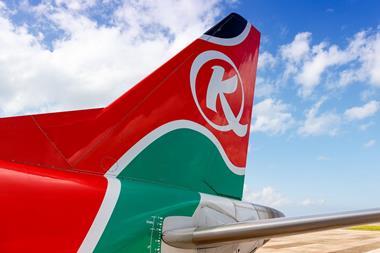
Kenya Airways is moving ahead with plans to add widebody freighters to support its ambitions to grow cargo’s contribution to group revenues from 10% to 20% this year.
Speaking to Air Cargo News, cargo director Fitsum Abadi Gebrehawaria outlined plans for the near-term introduction of Boeing 767 freighters as part of a longer-term ambition to operate Boeing 777Fs.
Adding widebody freighters is a central pillar of its cargo-first strategy.
Abadi said Kenya Airways plans to add its first 767 freighter by the end of the first quarter, with a second aircraft expected to follow a few months later.
The aircraft will act as a bridge to future widebody growth, with the airline ultimately aiming to operate three Boeing 777 freighters by the end of the decade.
“We may transition with 767-300 but with our strategy between now and 2030, we are planning to have three 777Fs,” he said.
Kenya Airways currently operates four narrowbody freighters: two Boeing 737-300s and two 737-800s, the latter introduced in 2024.
According to Abadi, widebody freighters will allow Kenya Airways Cargo to capitalise more effectively on Asia Pacific demand, with Guangzhou and potentially Hong Kong identified as destinations.
Initial operations using 767 capacity could include a technical stop in the Middle East, catering for perishable demand, before returning with e-commerce cargo.
Abadi said the airline’s preference is for the 777F, but limited availability has made immediate acquisition challenging.
As a result, the 767 has emerged as a more accessible option in the short term.
The fleet expansion is part of a wider effort to stabilise the airline’s revenues by growing cargo’s role within the business.
Abadi said cargo offers resilience against passenger market volatility, which remains a challenge for African carriers.
Alongside fleet growth, Kenya Airways Cargo is investing in supporting capabilities, including digital systems to improve capacity planning, tracking and yield management.
“We are also working on digital transformation, on acquiring an industry-based cargo system for capacity planning, real-time cargo tracking and to optimise yield,” Abadi said.
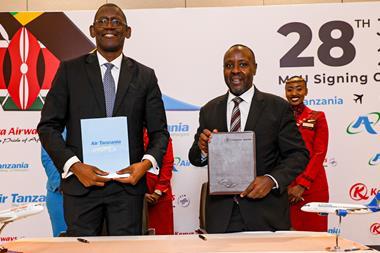
The airline is also strengthening its network reach through partnerships. It has signed memorandums of understanding with Qatar Airways and Air Tanzania and maintains interline agreements with carriers including China Southern, Saudia, Turkish Airlines, Ethiopian Airlines and Bluorbit.
“Interline agreements help us to access offline markets and so this will help us to grow the cargo revenue,” Abadi added.
Furthermore, the carrier is further investing in its specialised solutions for pharma, perishables, e-commerce, express and courier to complement its strength in perishable exports.