




National Transportation Safety Board investigation finds aircraft failed to achieve normal climb rate before left engine detached from wing
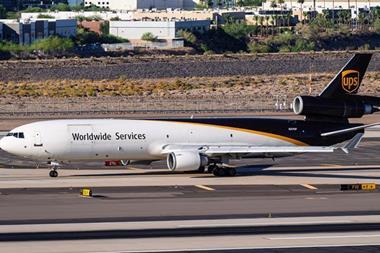
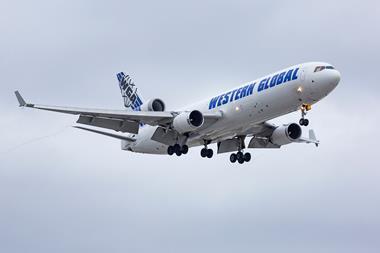
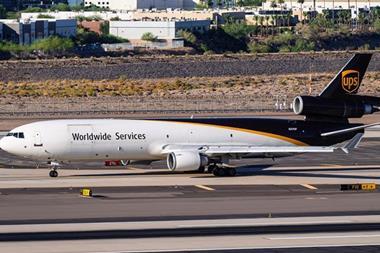
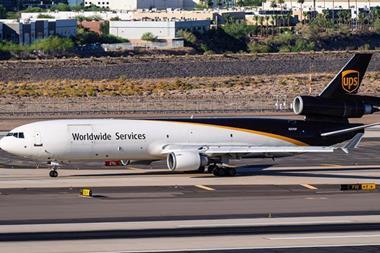
The UPS MD-11 freighter that caused 14 fatalities when it crashed shortly after takeoff in Louisville did not have a normal climb rate and began to lose altitude, while fatigue cracks were also found on the aircraft.
These findings were outlined in the preliminary report from the National Transportation Safety Board (NTSB) for domestic cargo flight 2976, which crashed at Louisville Muhammad Ali International Airport (SDF) in Kentucky on 4 November.
The three-engined widebody aircraft, N259UP, which was due to fly to Daniel K. Inouye International Airport (HNL), Honolulu, Hawaii, "initially climbed but did not get higher than about 30 ft above ground level”, found the report.
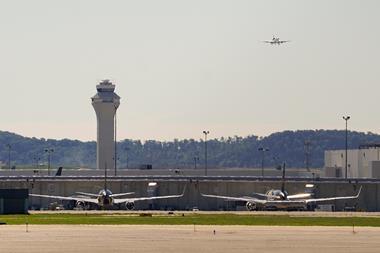
Further detail provided stated: "A witness in the SDF ATC tower reported that the takeoff speed appeared normal for that type of aircraft; however, the climb rate was not normal, as the airplane did not climb above the tower’s height of approximately 200 ft above ground level. Another witness reported that the airplane stopped climbing and began to lose altitude before rolling slightly to the left.”
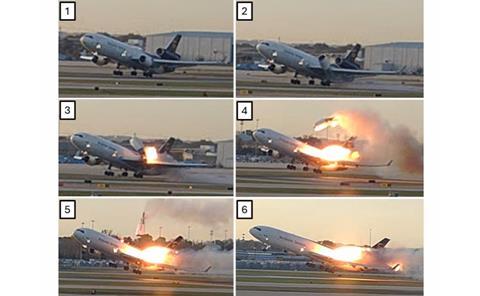
An airport surveillance video of the airplane showed the left (No. 1) engine and pylon separating from the wing shortly after airplane rotation, with a fire igniting on the left engine while it traversed above the fuselage and subsequently impacted the ground, as depicted in the still images from the airport surveillance video.
The aircraft impacted several building structures before reaching the ground.
Stress fractures were also discovered on the components of the aircraft. The report stated that "examination of the left pylon aft mount lug fractures found evidence of fatigue cracks in addition to areas of overstress failure".
The report added: "On the aft lug, on both the inboard and outboard fracture surfaces, a fatigue crack was observed where the aft lug bore met the aft lug forward face. For the forward lug’s inboard fracture surface, fatigue cracks were observed along the lug bore."
The left (No. 1) and right (No. 3) engines of the MD-11 airplane are attached to the underside of pylons that are in turn attached to the underside of each wing. The center (No. 2) engine is attached to the base of the vertical stabilizer. The left and right pylon attaches to their respective wing via a forward mount bulkhead, a thrust link assembly, and an aft mount bulkhead.

The flight had received takeoff clearance and the flight crew acknowledged this takeoff clearance, found the report.
As well as the fatalities of the three crew aboard the freighter and 11 people on the ground, there were another 23 others on the ground that were injured.
Earlier this month, the Federal Aviation Administration (FAA) issued an Emergency Airworthiness Directive (AD) ordering owners and operators of MD-11 freighters to ground their aircraft and inspect them for for faults.