




Integrator fast-tracked retirement plans after grounding 26-aircraft MD-11F fleet, repositioning network capacity to maintain peak season operations
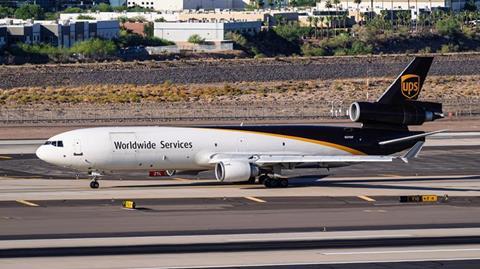
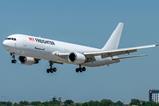
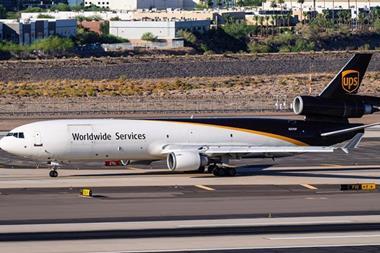
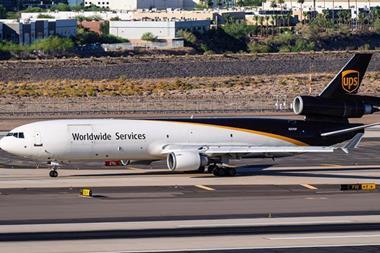
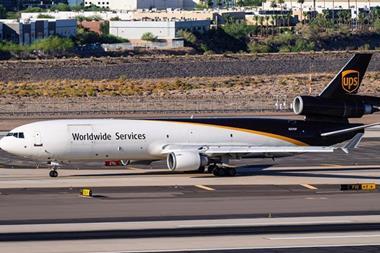
UPS has confirmed it retired all its MD-11 freighters in the fourth quarter of 2025 and will replace these aircraft with Boeing 767Fs following last year's fatal crash and subsequent grounding.
The US express specialist said it had made the decision to accelerate its fleet modernisation plans in its latest earnings release. Five 767Fs are due to be delivered in the first half of this year and 10 in the second half. Three more units are due in 2027.
UPS chief executive and director Carol Tomé said in the company's fourth quarter earnings call on 27 January: "Our airline is a key part of our network. And over the past several years, we've taken a systematic programmatic approach to modernizing our global air fleet.
"To that end, we made the decision to accelerate our plans and retire all MD-11 aircraft in our fleet. Over the next year or so, we will replace much of that capacity with new, more efficient Boeing 767 aircraft."
Brian Dykes, chief financial officer and executive vice president, further explained: "During the fourth quarter, we proactively grounded our fleet of MD-11 aircraft and leveraged the flexibility of our integrated network to seamlessly operate through peak season.
"Specifically, we repositioned some aircraft from other parts of the world to the U.S. We increased the amount of volume we moved on the ground, and we leased additional aircraft to meet capacity demand.
"With the learnings from operating during peak season, we made the decision to accelerate the retirement of our MD-11 fleet, which was completed in the fourth quarter.
"Over the next 15 months, we expect to take delivery of 18 new Boeing 767 aircraft with 15 expected to deliver this year. As new aircraft join our fleet, we will step down the leased aircraft and associated expense. We believe these actions are consistent with building a more efficient global network positioned for growth, flexibility and profitability."
Cirium data showed that UPS had a fleet of 26 in-service MD-11Fs, with six more aircraft in storage, before the fatal crash of a UPS MD-11F on 4 November last year.
The Federal Aviation Administration (FAA) subsequently issued an Emergency Airworthiness Directive (AD) that ordered owners and operators of MD-11 freighters to inspect their aircraft for faults.
The UPS domestic cargo flight 2976 incident involved the left-hand engine and pylon detaching from the airplane during takeoff from Louisville’s Muhammad Ali International Airport (SDF). There were 14 fatalities as a result of the incident.
The National Transportation Safety Board's (NTSB) preliminary investigation report found that the aircraft did not have a normal climb rate and began to lose altitude, while fatigue cracks were also found on the aircraft.
Air Cargo News' sister magazine, FlightGlobal also reported this month that Boeing in 2011 told airlines to watch for potential failures of a pylon bearing assembly.
In addition to UPS, FedEx and Western Global Airlines also operated MD-11Fs. According to Planespotters, FedEx has 29 MD-11Fs in its fleet, but these are all parked. Western Global also has 15, all of which are parked, data from the site shows.
However, MD-11Fs have been largely operated on domestic routes and therefore removing them from service is not expected to have a major impact on international cargo capacity levels.
UPS 2025 financial results
MD-11Fs aside, UPS said total 2025 revenue was $88.7bn, down 2.6%. Operating profit was $7.9bn, down 7.1%.
But the company also had to factor in a non-cash, after-tax charge of $137m due to a "write-off of the company’s MD-11 aircraft fleet".
In terms of divisional performance, the International Package division saw revenue rise 3.4% to $18.6bn, but operating profit fell 10% to $2.9bn.
US Domestic Package revenue was $59.4bn, down 1.4% year on year. Operating profit was also down 9.6% to $3.8bn.
Supply Chain Solutions revenue was down 17% to $10.6bn, however operating profit was up 14.6% to $1.1bn.
UPS took some major staffing steps to improve profitability last year. In April 2025, UPS announced it would cut around 20,000 jobs as a result of its decision to reduce its business with e-commerce platform Amazon.
But with the October 2025 release of its third-quarter results, UPS confirmed it had in fact reduced operational headcount by some 34,000 positions, while management positions were down by 14,000.
In line with this, Tomé said in the latest earnings call: "By the end of the year, we reached our volume reduction target and reduced Amazon's volume in our network by approximately 1m pieces per day."
Dykes also noted that in the fourth quarter: "Total air average daily volume was down 11.9%, driven by the glide down of Amazon."
During the year, UPS also completed its acquisitions of Frigo-Trans and Andlauer Healthcare Group, further expanding its healthcare cold chain capabilities.
The company's new air hub in the Philippines is due to open towards the end of 2026, while its air hub expansion at Hong Kong International Airport is on track to open in 2028.
"Both gateways give us broader access and faster time in transit in the trade lanes that are growing in Asia," said Tomé.
For the full year 2026, on a consolidated basis, UPS expects revenue to be approximately $89.7bn.
"In 2026, growth in the US small package market, excluding Amazon, is expected to be up low single digits. Outside the US, export volume growth is expected to be subdued, partly due to the tough comparisons coming from the boost of tariff front running in 2025," commented Tomé.
She further stated: "Looking ahead, upon completion of the Amazon glide-down, 2026 will be an inflection point in the execution of our strategy to deliver growth and sustained margin expansion."
Setting out expectations for the International segment, Dykes said: "We expect the dynamic environment we experienced in 2025 will continue in 2026, primarily due to the tariff and de minimis policy changes that will continue to drive changes in trade lane mix.
"With that in mind, we anticipate revenue growth to be in the low single digits year-over-year, driven by a solid increase in revenue per piece. Operating margin in the International segment is expected to be in the mid-teens.
"Looking at the first quarter, we expect revenue to be approximately flat with the year-over-year decline in operating profit due to changes in trade lanes and tough comps from the front running of tariffs and de minimis changes in 2025."