


The typical person in the airfreight industry is male and middle-aged, and in perhaps fewer years than we realise, those people will be older, and on the cusp of retirement.
There is nothing wrong with middle-aged men, of course, but the industry needs to become more diverse in where it recruits its talent from.
If things don’t change soon, “I think it could struggle,” says Eliska Hill, senior vice president of cargo at broker Air Partner.
The freight industry has always faced a battle in presenting itself as an interesting, worthwhile career to potential recruits.
This is a pity because, as Hill herself can attest, it really is a worthwhile and fulfilling place to work for those who get bitten by the bug. It’s getting the bug to bite in the first place that has always been the problem.
Hill has vivid memories of being the only female in a room full of over 60 - yes, middle-aged men - at an industry conference. “I think quite a few of them wondered what I was doing there.”
Coming from an aviation family, her first thoughts turned, as well they might, to becoming a pilot.
That didn’t work out, but her enthusiasm led her to a Transport Management degree at Loughborough University, followed by a first job at Africa specialist MK Airlines in 1996.
Today, the industry is more diverse – today’s female executives might have a bit of company at industry get-togethers - but it still could do a lot better.
“In our US office in Atlanta, for instance, there are more women than men, but that’s the exception.”
Still, Air Partner is probably doing better than many of its peers in this respect. Many of its people who staff its 24-hour control towers are women too, which gives the lie to the assertion that you cannot get women to work night shifts.
There’s also a thriving Ladies’ section of the UK Air Cargo Association.
“There were 60 at the recent Ladies Lunch, all looking very glamorous,” Hill recalls.
Digitalisation in airfreight has also helped attract more women into the industry, she adds. “We’re succeeding, slowly, but more needs to be done.”
Attracting the next generation
There’s also a major issue with getting young people – of any gender – interested in airfreight.
This has been the motivation behind setting up the Air Partner Academy which, in the three years since it was launched in 2022 has already achieved some notable successes.
“It is really important to focus on peoples’ early development in the industry, making it as exciting and as relevant to them as can be," says Hill. "We need to show them how everything in your life – whether it’s the mobile phone in your hand, or the different fruits that you can enjoy at any time of year now – is all because of logistics.”
The Academy, which is based at Air Partner’s main UK base at Gatwick, is aimed at young people, typically 18 or 19, looking to start their career journeys.
“We want to get that message out there to people – if you have a son or daughter who is interested in a career in aviation, this gives them a wonderful platform from which to start.”
“We want to get that message out there to people – if you have a son or daughter who is interested in a career in aviation, this gives them a wonderful platform from which to start.”
Air Partner aims to get its Academy members involved in all aspects of the business and to encourage them to use their knowledge and creativity to come up with real solutions to real problems.
With the help of its experienced team, it runs realistic simulations of actual jobs to help students get to grips with what they will encounter in the real world of air charter broking.
“And we now have some great role models; people like Millicent Davies (currently time critical account manager at Air Partner) who even went back to her old school – on her own initiative - to tell them all about her role and what she does," says Hill.
It’s all very different from her first day in an air broking job, at another company: “I was given a laptop and phone and just told to get on with it. That’s something we would like to avoid as much as possible at Air Partner.”
She herself can look back on a long and varied career in the air broking side of the business, passenger as well as cargo.
Cleaning up the inside of a private jet after a flock of falcons had been let loose inside, or helping to hurriedly restage the 2002 Miss World contest in the UK after local protests made it impossible to hold it in Nigeria.
Global expansion
Hill’s long experience of the airfreight and broking industries is now standing her in good stead as she expands Air Partner’s cargo presence around the globe.
The first task will be to extend the network of 24/7 ‘control towers’ – replicating that already established in the UK – first to Atlanta in the US and then to the Middle East, which Hill foresees “will be the real growth area this year”.
Air Partner already has good relationships in this region, so it isn’t starting completely from scratch.
The Middle East control tower will also service Africa and parts of Asia and, in the longer term, the plan is to also set up a 24/7 operation within Asia itself.
At the same time: “We’re also looking to create a hybrid service in which we offer additional door-to-door services, offering customs brokerage, ‘direct drive’ road services and so on. It’s not just a matter of finding the customer a flight, but doing everything we can to reduce their pain, to take away the stress.”
Aircraft spares are Air Partner’s biggest industry segment and that activity is particularly busy right now.
“We’re in the summer season, so airlines are putting on extra flights. Also, fleets are ageing, because production of new aircraft has been delayed, so carriers are having to keep older aircraft running, which means more spares are needed.”
"Fleets are ageing, because production of new aircraft has been delayed, so carriers are having to keep older aircraft running, which means more spares are needed.”
As a Wheels Up company – which in turn is now owned by Delta Air Lines – Air Partner is steeped in aviation expertise. While Air Partner is active in some other segments, such as marine spares, car parts and oil and gas, the heart of the business is urgent plane parts.
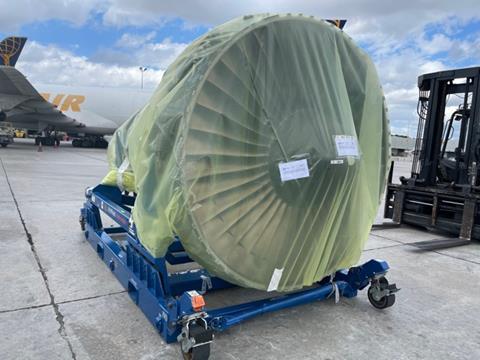
Its experts understand the nature of the pieces of cargo that they move, to a much greater extent than would be expected in most parts of the logistics or freight forwarding industry: “They know what a thrust reverser does, where they are sourced, what type fits which aircraft, and also what aircraft cargo holds it will fit inside.”
They even know that it is possible to fit a piece into a specific plane by temporarily removing a panel – which may well save the client the cost of chartering the next aircraft size up.
This sort of knowledge is impossible to replicate with even the cleverest artificial intelligence software, which means that it will always be heavily reliant on its human expertise.
“In this industry, people can see right through you if you don’t have the requisite expertise. That is why having the right people in place is so important to this business.”