



Kansas Modification Center (KMC) founder Jim Gibbs sees the 787 as a direct replacement for the 767F, citing fuel efficiency gains that could deliver significant economic benefits
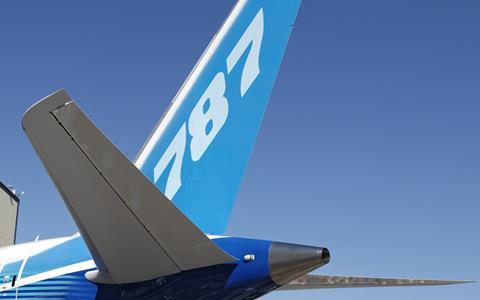
Freighter conversion specialist Kansas Modification Center (KMC) expects eventually to develop a cargo-modified Boeing 787, an aircraft the firm’s chief views as having potential to be an exceptional freighter.
KMC, now busy developing a converted 777-300ER freighter, is not alone in considering such a programme.
Israel Aerospace Industries (IAI), which recently received received a Supplemental Type Certificate (STC) from the US Federal Aviation Administration (FAA) for its 777-300 conversion and which has now seen the first two 777-300ERSFs from the programme delivered to launch operator Kalitta Air, has also flagged the opportunity for a cargo-carrying 787.
“The next one will be the 787,” KMC founder and chief operating officer Jim Gibbs told Air Cargo News' sister magazine, FlightGlobal, while clarifying his company is for now “just studying” the concept.
He suspects KMC will launch its 787 conversion programme in roughly two years, after it gets its 777-300ER conversion effort “on a good footing”, adding: “We’ve got to raise a lot of money.”
KMC is not the only company considering the development of a 787 conversion. Two years ago, Israel Aerospace Industries (IAI) said it was also considering developing a programme. The model would offer a payload in the 60 tonne range, meaning it would compete in the medium-widebody sector against the likes of the A330 and ageing Boeing 767, IAI said.
KMC is now busy developing its first “777-300ERCF” and aims to secure that aircraft’s supplemental type certificate in late 2026.
Gibbs sees a 787 freighter – particularly one based on the -8 variant – as a “direct replacement” for the popular 767F, which Boeing plans to stop producing in 2027.
Noting the Dreamliner’s significantly better fuel efficiency, Gibbs says a 787F would enable cargo operators to experience the same economic gains that passenger airlines have reported after placing the twinjet into service. “The 787 effect”, Gibbs calls it.
Boeing’s Dreamliner remains a relatively young aircraft, with the first entering service in 2011 with All Nippon Airways. Airlines globally now operate about 380 787s, of which 280 are at least 10 years old, according to fleet data provider Cirium.
No conversion shops have publicly committed to 787 projects, nor does Boeing offer new-build 787Fs. The company has, however, said it is working on updates to the aircraft and some analysts suspect it may be eyeing a freighter variant to fill a market gap that will emerge when 767F production ends.
Boeing plans to halt 767F output after delivering all the aircraft in its backlog. At the end of September, it held 27 orders, according to company data, meaning production could stop next year.
KMC’s Gibbs says a 787 passenger-to-freighter conversion would be “a bit more complicated” than modifying a jet like the 777, owing to the type’s carbonfibre fuselage.
“Yes, it’s going to have more in-depth procedures and processes,” he says. “It’s going to have more technology to it. Less hand work, more automation,” plus advanced inspection techniques.
The 787 also makes extensive use of titanium, rather than the aluminium that features in most other jets, Gibbs notes.
Last year, an executive at IAI told Air Cargo News that his firm was considering a 787 conversion, noting that airlines in the coming years will increasingly phase the type out from passenger service.
“This aeroplane is something else because it is constructed with composite materials. I’m sure we’ll find a way to do it, but it is a different animal and something that we haven’t done yet,” the IAI executive said.