


Conversion specialist Kansas Modification Center has pushed back expected FAA approval for its Boeing 777 freighter programme to late 2026

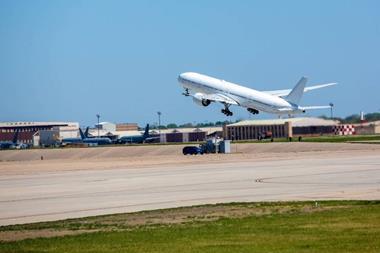
Boeing 777-300ERCF. Photo: Telair
Conversion firm Kansas Modification Center (KMC) is now hoping to achieve US Federal Aviation Administration (FAA) approval for its Boeing 777 programme later next year.
Air Cargo News sister title FlightGlobal reports that the company has pushed back the date of expected Supplemental Type Certification due to an extended engineering/flight testing timeline and delays on the FAA side.
Most recently, FAA staff working on the project have stopped work due to the federal government shutdown. KMC founder and chief operating officer Jim Gibbs added that the FAA’s inconsistent requirements have also slowed the process.
KMC had originally hoped to have gained an STC for its 777-300ERCF conversion in 2024.
“The engineering took a little bit longer than what was expected”, as did pre-modification flight testing, which involved “widespread fatigue-damage tolerance” evaluations, Gibbs said.
However, he added that work is progressing well and the company expects significant demand for its programme thanks to its unique forward door that is calined to improve ease of loading.
In total, there are three companies offering a 777 conversion programme.
In September, Israel Aerospace Industries (IAI) annoucned it had received a Supplemental Type Certificate (STC) certificate from both the US Federal Aviation Administration (FAA) and the Civil Aviation Authority of Israel (CAAI) for its Boeing 777-300ERSF passenger to freighter (P2F) conversion.
IAI also faced delays to its programme. It had been hoping to receive approval from the CAAI by the end of 2022 and the US FAA soon after but faced several delays.
Meanwhile, Mammoth Freighters’ 777-200 programme is undertaking final test flights as it progresses towards Supplemental Type Certification (STC) for the aircraft.
Backbone Freighter Leasing is the launch customer for KMC’s programme, having ordered three of the aircraft back in 2022.
While the programmes are likely to prove popular, given the expected tight supply of widebody freighters over the coming years, they also face challenges.
In a recent webinar, market intelligence firm IBA said that feedstock is proving hard to find.
“A critical shortage of feedstock due to high passenger market retention is limiting the pace at which these aircraft can enter the freighter fleet,” IBA said.
IBA explained that high residual values and sustained passenger demand had resulted in passenger airlines holding onto their 777-300ER fleets longer than planned.
Some carriers are even refurbishing cabins, “indicating extended passenger service life”, IBA added.
Meanwhile, these developments are also driving up the cost of converting a 777-300ER, which will put pressure on future margins.
“IBA estimates that a converted 777-300ERSF in half-life condition is likely to cost between $75–80m, with costs rising closer to $100m if the GE90-115 engines require a shop visit.
“The combination of low feedstock and conversion costs means that operators and lessors will need to commit significant capital, potentially limiting the market to those with strong financial backing.”