



Eleventh Circuit ruling halts DOT directive targeting nine-year partnership as US-Mexico aviation tensions escalate over cargo operations

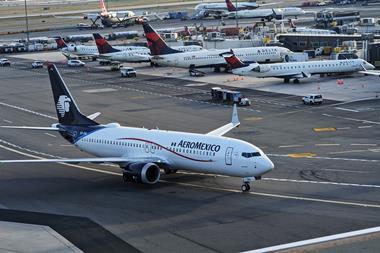
The United States Court of Appeals for the Eleventh Circuit has temporarily halted a Department of Transportation (DOT) order of 15 September to force Delta Air Lines and Aeromexico to unwind their joint venture (JV) by 1 January.
The airlines had gone to court to block the DOT order to repeal the nearly nine-year-old JV in which the carriers coordinate on US-Mexico flights.
The DOT order was issued in September as part of several actions taken by the US aimed at Mexico’s aviation sector in light of its anti-competition concerns.
The order would terminate antitrust immunity and withdraw the approval the DOT had previously given to the Joint Cooperation Agreement between Aeromexico and Delta.
An Aeromexico statement noted that the effectiveness of the DOT’s order is now “stayed pending resolution of the judicial review”.
This is the latest move in a long-running saga.
In July this year, the US government placed restrictions on Mexico’s air cargo and passenger operations in response to what it said was “abuse” of the 2015 US-Mexico Air Transport Agreement and ongoing anti-competitive behaviour.
According to the DOT, Mexico has not been in compliance with the agreement since carriers were required to move cargo operations from Benito Juarez International Airport, known as Mexico City International Airport (MEX), to Felipe Angeles International Airport (AFIA).
Cargo operations were moved from MEX to AFIA to reduce congestion, a decision that was criticised by IATA and the DOT said the action served to disrupt the market.
It said: “In 2023, Mexico unilaterally forced all U.S. all-cargo carriers out of MEX under the same saturation pretences with only 108 business days advance notice.
“Mexico has not taken any action to restore the operating rights of U.S. all-cargo carriers guaranteed in the U.S.-Mexico Air Transport Agreement.”
A couple of months later, the US government ordered Delta and Aeromexico to dissolve their JV, part of that ongoing disagreement with Mexico over the 2015 U.S.-Mexico Air Transport Agreement.
The country’s behaviour is anti-competitive and disadvantages U.S. carriers, and means Delta and Aeromexico have an unfair advantage, the US DOT said then in a press release.
“Mexico’s non-compliance intervenes in the market to provide an unfair advantage to Delta and Aeromexico, who operated a price- and capacity-setting joint venture with conditional approval by USDOT,” it declared.
The Delta-Aeromexico JV must wind down by 1 January 2026, the DOT urged, saying that Delta/Aeromexico would be required to discontinue competitively sensitive activities such as common pricing, capacity management and revenue sharing that require antitrust immunity.
However, Delta and Aeromexico would be able to continue their partnership through arms-length activities such as codesharing, marketing, and frequent flyer cooperation, it conceded.
But the decision of the Eleventh Circuit Court puts all that in some doubt, at least for the moment.
Earlier this month, the Airforwarders Association (AfA) warned against the reduction in air cargo capacity and of disruption in supply chains that is likely to follow the US government’s withdrawal of 13 routes operated by Mexican airlines.
US Transportation Secretary, Sean Duffy, announced the decision to prevent several Mexican carriers from operating passenger flights into the US at the end of October, removing valuable bellyhold capacity.
But Brandon Fried, AfA executive director, said: “The loss of these flights won’t just affect passengers; it pulls critical cargo capacity out of the market.”