



Latin American airfreight carriers are adding air cargo capacity as they anticipate healthy demand off the back of trade that appears safe from tariff disruption as well as e-commerce and network diversification.
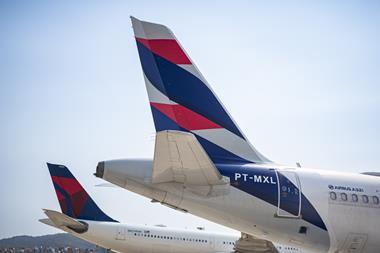
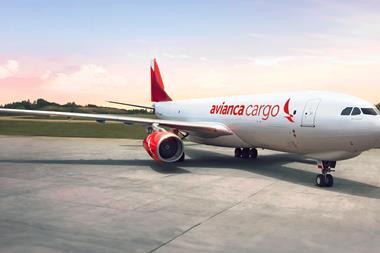
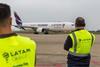
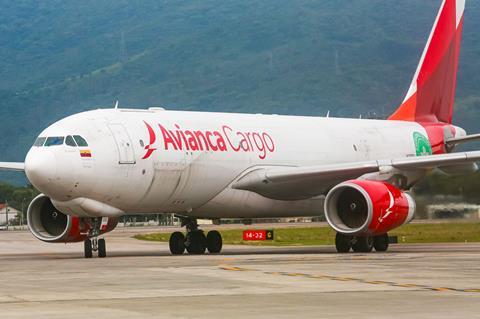
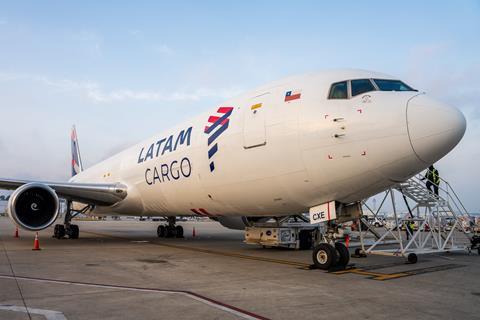
The region’s largest carriers are adding freighter capacity this year. Avianca is taking delivery of two Airbus A330 passenger to freighter (P2F) aircraft, bringing its maindeck line-up to nine aircraft, and LATAM is waiting for the arrival of the final converted Boeing 767 freighter of its order.
The modification is completed, but the carrier is awaiting certification of a new fire suppression system from the US FAA. It intends to install the new system on all its freighters, says LATAM Cargo chief executive Andrés Bianchi.
One of Avianca’s A330P2Fs will be deployed with Mexican partner airline Aerounion. Avianca Cargo chief executive Diogo Elias is wary of putting too much capacity into the Latin American market, lest this would dilute yields.
Regional yields were strong in the latter half of the year. A big reason for this was the decision of several international carriers to shift freighters from Latin America to routes from China across the Pacific and to Europe.
Lufthansa, Air France KLM Martinair Cargo (AFKLMP), Cargolux and Qatar Airways all cut their maindeck presence in the market.
However, AFKLMP came close to replacing the lost capacity through a combination of leveraging its passenger network in the region and funnelling traffic through other airlines like GOL to its transatlantic gateways, reports Enrica Calonghi, director South America.
The European carrier has also moved cargo by ship from Peru to Panama to feed its departures to Europe. “It worked, but it required a lot of work behind the scenes,” Calonghi says.
Q1 growth sustained
Growth in volumes continued in the first quarter. “In the Latin American region, we have observed robust demand in both directions,” reports Lorena Sandoval, sales director for Florida, the Caribbean and Latin America at American Airlines Cargo.
The airline has launched a seasonal operation between Rio and Dallas/Fort Worth and expanded its Rio-New York service to daily flights. In December, it plans to add a fourth daily flight to Buenos Aires.
Sandoval notes that lately rates have softened, particularly in markets like Sao Paulo’s Guarulhos airport and Buenos Aires, where overcapacity has been reported.
E-commerce pouring into Latin America has been a huge driver of volume growth and it continues to stimulate new freighter activity. A large Chinese logistics operator has mounted twice-weekly flights via Brussels to Lima with a leased 777F, Elias says.
Since early April, Avianca has bought most of the space on the eastbound leg of the operation. Most of this traffic consists of flower shipments, which are trucked from Maastricht to Amsterdam, while some traffic is trucked to Madrid and other European destinations.
RIOgaleao, which operates Rio de Janeiro’s Tom Jobim International Airport, is also getting a shot in the arm from e-commerce. It signed a contract with a large Chinese e-commerce operator for a dedicated handling operation that unleashed a torrent of parcels, which stood at 80,000 parcels a day in April and is expected to rise to 130,000 in a few months.
In April, the operation saw a test flight coming in via Brussels, which could turn into a regular service, says Patrick Fehring, RIOgaleao’s aero business director.
“We will be the biggest gateway in Brazil for this customer,” he says, adding that currently the operation requires about 12 tons of capacity a day, which can be covered with bellyhold lift, but growth projections point to a need for freighter service down the road.
To serve this client, the airport operator has allocated 1,200 sq m of dedicated space in its warehouse and recruited 60 personnel.
“We’re in discussions with a second operator that wants the same set-up,” says Fehring. “This makes us think that we may want to look at a dedicated warehouse for e-commerce.”
At Montevideo’s Carrasco International Airport, Latin America Cargo City (LACC) is spending over $10m on the construction of a 5,000 sq m building to handle e-commerce.
The new facility, which is slated to open its doors in the second half of next year, will have automated vertical storage systems for parcels, multi-range cold storage rooms, and dedicated individual workspaces for exclusive operations.
Until last year the multimodal logistics airport free zone's e-commerce traffic grew at about 15% a year, but the arrival of Temu in Uruguay halfway through 2024 triggered a surge that saw a 170% increase in parcel volume in the second half of the year, reports LACC general manager Bruno Guella, adding that other e-commerce platforms have shown interest in expanding into Uruguay.
The parcel business appears poised for further growth. Mercado Libre, the largest e-commerce platform in Latin America, plans to invest altogether $13.2bn this year on expansion. Last year’s revenues jumped 38% to $21bn.
“The Latin American e-commerce boom continues, particularly in key markets such as Brazil, Mexico, Colombia, Chile and Argentina. Growth in e-commerce is strong in fashion, electronics, health and beauty sectors. As online shopping continues to expand, we are seeing an increasing flow of goods, which significantly contributes to our overall cargo volumes,” remarks Sandoval.
More shipment choices
Fehring says that RIOgaleao would not have been able to attract an international e-commerce operation without a change in Brazilian regulations that lifted the requirement to move e-commerce within the nation through the postal service, a regime that funnelled all incoming parcels to Sao Paulo.
Now e-commerce providers can make their own arrangements, which also allows them to pick their gateways.
This development coincides with increased interest among cargo owners and forwarders in direct flights to airports in the region other than the main gateways. LATAM has seen strong interest from European clients in more points in Brazil, reports Bianchi.
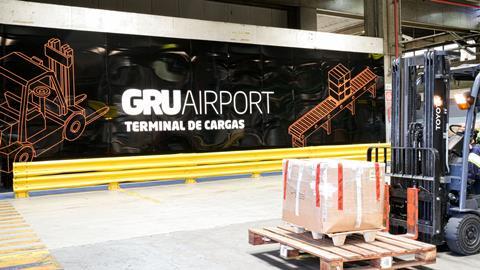
A secondary impetus for the interest in alternative airports in Brazil is a desire to avoid Guarulhos International Airport (GRU) in São Paulo, the region’s top gateway, after a dramatic meltdown in cargo capacity last year that led to massive delays and rows of containers in the open after warehouses had filled up to the rafters.
The airport has taken measures to improve operational performance, but not to the extent that carriers would like to see. “They still have ways to go,” says Bianchi.
Another airport development of note is the new terminal at Lima’s Jorge Chavez International Airport that is set to open in June, half a year later than planned.
“It’s going to be a challenge for the cargo business. The layout is not as friendly as originally designed,” says Bianchi.
Some airports have taken steps to beef up their digital capabilities. Logistics technology provider Kale Info Solutions has been selected by Bogota’s El Dorado International Airport to implement a cargo community system (CCS), the first in South America.
And in Mexico, Kale signed an agreement with Mexico Cargo Handling to digitise operations through its Galaxy CCS.
For RIOgaleao, aerospace business was again the biggest driver of cargo growth, thanks to GE, which has its largest MRO facility outside the US there.
It handles about 25% of the firm’s engine overhauls, which should translate into some 630 engines arriving at the airport this year.
Oil and gas has also been strong and is expected to grow as Brazil ramps up production. This business is another major driver of maindeck service, notes Fehring.
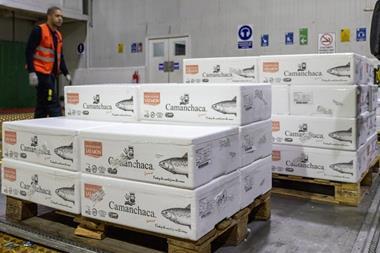
AFKLMP was set to add Georgetown to its freighter schedule in mid-May in response to buoyant oil and gas extraction in Guyana. Elsewhere, the carrier intends to add a second weekly flight to Lima, as Calonghi expects stronger output of berries and mangoes there this year.
“Outbound demand from the region has increased, especially flowers,” says Elias.
Safe trade?
The tremors from Washington’s tariff salvo have been felt in South America, but arguably less than in many regions, as it has not been a major target of these.
This has led to speculation that it could see increased interest in nearshoring. At the same time, there is talk about a potential diversification of its exports.
Calonghi is encouraged by the trade agreement signed this year between Mercosur and the European Union and she has seen interest in markets in Asia and the Middle East. “Peru and Brazil are looking at new markets,” she adds.
Still, US-bound flows have been seemingly unaffected, and Bianchi doubts that a fundamental realignment is on the cards. The region’s proximity to North America is a major advantage vis-à-vis competing perishables exporters from other parts of the world, he notes.
In April, LATAM and Delta expanded their joint venture into Argentina, having obtained the regulatory approval from Buenos Aires. The cargo side has made less headway, partly due to the change in management at Delta. “We’re in the early part of the learning curve in terms of leveraging the combined networks,” says Bianchi.
Looking ahead, he sees the first priority in the partnership as improving their joint product, primarily on the operations side.
Avianca and Turkish Airlines stepped up their partnership last November, when the Istanbul-based carrier launched a freighter from Istanbul via Liege to Miami to connect with Avianca’s freighters.
While this enabled Turkish to offer its clientele a large number of destinations in Latin America, it gave its partner space on the eastbound transatlantic leg to sell European destinations to its customers. The pair are looking to increase the number of lanes covered jointly, such as Japan, India and some other Asian markets, says Elias.
Avianca Cargo has undergone a major transition over the past couple of years, overhauling its product portfolio, expanding the freighter fleet and ramping up performance. The emphasis on customer service, a central plank in the process, is reflected in the new livery unveiled in April with the moniker “we are doing it for you”.
Bianchi is looking at a significant change in how LATAM Cargo works, but says details will not be revealed before the company is ready to deploy the new setup, which is probably going to be near the end of the year.
“We’re working internally on a major transition on how we’re doing business,” he says. “It’s going to be by quite a margin the largest investment LATAM has ever done in its cargo business. We’re in the process of really transforming the way we’re set up.”