



Today’s shippers are more cost-conscious than ever, but there are still situations when airfreight is needed to fly unwieldy objects around the world.
In an ideal world, no one would take an object weighing up to 100 tonnes – or more – squeeze it into an aircraft and fly it thousands of miles to wherever it is needed.
Airfreight is expensive and often requires a lot of resources to be mobilised, to get the cargo to and from airports and on and off the aircraft.
In the real world, though, the best laid plans often go awry and there are many situations when the speed and dependability of airfreight is vital to get projects back on schedule, to prevent production lines from being shut down or to get a vital oilfield back into production with the minimum delay.
In fact, the heavylift sub-sector of the airfreight market thrives on uncertainty, and these are certainly uncertain times for global trade.
“We are definitely in a turbulent period, but I’m not pessimistic about the prospects for our heavylift airfreight business,” says Dan Morgan-Evans, global cargo director (and deputy chief commercial officer) for broker Air Charter Service (ACS). In fact, he believes, a bit of turbulence is actually good for the heavylift air cargo bookings.
The market is particularly hard to read at the moment. Availability of aircraft like 747 and 777 freighters has been tight ever since the Covid pandemic as e-commerce shippers have taken much of the available capacity, Morgan-Evans explains.
But then, US president Donald Trump’s ‘Liberation Day’ tariffs, when he announced them on 2 April, “effectively reduced charter rates, almost overnight”, he says. “It did actually help us, in a way, because lower prices do help people to head back into airfreight, so it was something of a silver lining.”
While price is often a secondary consideration for vital components and materials, some of the charter rates being quoted during the e-commerce boom were very high indeed, enough to make even the most hard-pressed shipper think twice.
The airfreight market remains volatile, says Morgan-Evans. Trump’s agreement with China in mid-May to reduce the substantial tariffs on each other’s goods for 90 days may have led global stock markets to surge, but the effect on airfreight capacity and prices is more uncertain.
Shippers may react by moving as much product as they can to the US – once again soaking up available capacity – or they could decide to wait and see.
During the Red Sea shipping crisis, when vessels were diverted onto the much longer routing via the Cape of Good Hope, there was initially a surge in demand for air solutions and a consequent increase in charter rates, but the market then settled down again, Morgan-Evans says.
“Shippers either made arrangements to take account of the longer voyages, or in some cases decided to carry on using airfreight," he explains.
Dynamic sector
Heavylift airfreight is also a very hard sector of the business to generalise about, because it encompasses so many different industries ranging from construction to mining, from automotive to alternative energy and, of course, long-time staple oil and gas.
Eliska Hill, senior vice president of cargo at Air Partner, says that while oil and gas has traditionally been a major sector for heavylift cargo, “we’re seeing a significant shift in demand toward renewable energy".
She adds: "Companies in cleantech manufacturing, data centres, and emerging technologies like direct air capture are increasingly in need of bespoke transport solutions, especially as their operations expand into more remote areas.”
Although growth in the conventional energy sector remains steady, it’s the renewable and sustainability-driven sectors that are showing the strongest momentum, particularly as they prioritise speed and reliability in their supply chains.
Air Partner is seeing a rise in demand for heavylift and outsize air cargo transport, fuelled in part by the ongoing growth of e-commerce and the increasing need for rapid, global goods movement. However, this is not being matched by a proportional increase in available capacity, resulting in notable supply-demand imbalances.
At the same time, shippers have become more cost-conscious due to a range of factors, including volatile fuel prices, cargo dimensions and weight, economic pressures, and airport-related fees.
Hill says: “At Air Partner, we work closely with clients to help them navigate these challenges, offering flexible, tailored solutions to ensure that even the most complex shipments are executed smoothly and efficiently.”
However, what all heavylift jobs tend to have in common are time constraints and, in many cases, accessibility issues. ACS is often asked to step in when, for instance, delays have occurred in a production schedule or there is a problem with shipping.
Airfreight may be the most effective way of getting something to a remote inland destination, particularly in Africa or the Middle East.
Most of ACS’s customers for heavylift airfreight are forwarders, who generally arrange the land logistics of air movements, with ACS taking care of the airside-to-airside element, though it is something that ACS can organise itself if required.
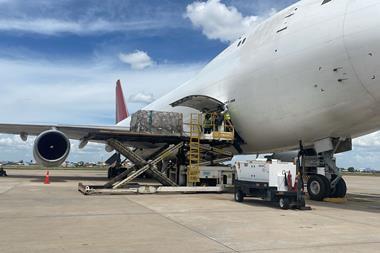
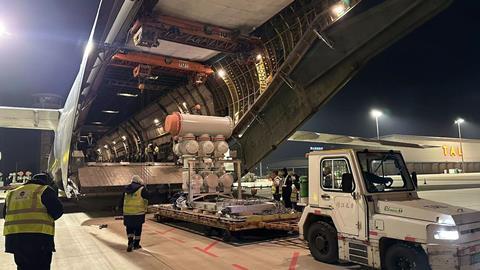
However, getting large items on and off aircraft is in itself an involved process and, like all good brokers, the team also has an encyclopaedic knowledge of the capabilities and available equipment at airports around the world.
Where possible, ACS prefers to use airport equipment as bringing gear from outside is expensive, but this can be done if needs must, says Morgan-Evans.
Big aircraft in short supply
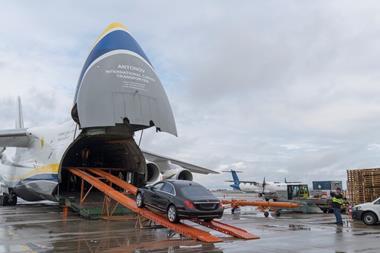
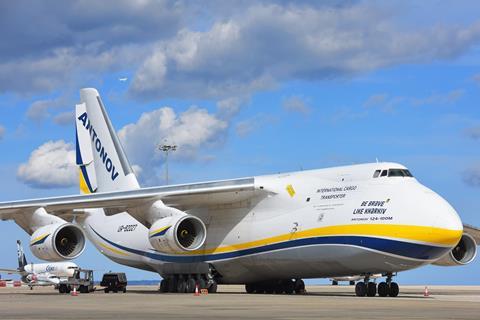
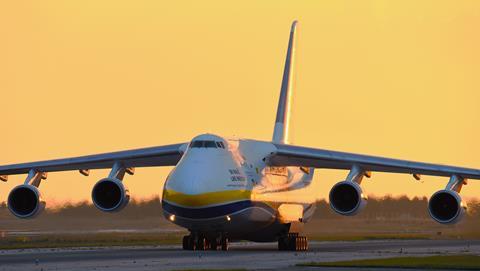
Supply of capacity in the ultra-large segment of the market – essentially the Antonov 124 fleet – has also been constrained since Russia’s invasion of Ukraine. Half the global fleet of AN-124s, namely those that are operated by Russia’s Volga-Dnepr, has been effectively off-limits due to sanctions, leaving only the aircraft operated by Antonov Airlines, now based in Leipzig in Germany.
That fleet is also busy with Ukraine’s own requirements, so again charter rates for the aircraft are high, “though that’s understandable”, explains Morgan-Evans. “It’s a very unique product.”
Antonov Airlines is the biggest operator, and indeed almost the only operator of the AN-124-100 in Europe, North America and Australia. (Maximus operates a single example but only for certain cargo types as it lacks special loading equipment.)
Antonov says: “The AN-124-100(150) aircraft allow us to transport cargo that no other type can handle, so we are focused on this area to ensure delivery of super-heavy and oversized cargo.
"Another important area of activity is transportation under a contract with NATO. And since 2022, we have been providing accessibility to transportation in the interests of the government of Ukraine as a priority. Peace and security come first.”
As far as the civilian sector is concerned, the two most important areas for Antonov Airlines are aerospace and the oil and gas industry. The future market is very difficult to predict, owing to Ukraine’s unique situation.
At Air Partner, Hill also confirms that capacity for outsize airfreight remains constrained, particularly with the limited availability of the Volga-Dnepr fleet and Airbus’s decision not to commercialise the Beluga 600ST for general market use.
Airbus has now given up commercial operation of the Beluga ST, a bespoke aircraft based on the Airbus A300-600 with a massively distended upper superstructure originally designed to move aircraft wings.
While ACS did consider it when it was available, “it was designed for a very specific purpose and it had a very difficult weight limit", Morgan-Evans explains.
However, the restricted supply of the aircraft hasn’t prevented ACS from doing a substantial number of charters.
“If anything, they have increased, though I suspect that we could have probably done a lot more if there had been more availability and more competitive pricing. Bringing rates down tends to bring more people into the market,” Morgan-Evans comments.
Interestingly, while the supply of AN-124s is currently tight and availability “spotty”, it has been even tighter in the past. He adds: “In the early 2000s, we couldn’t get 124s for weeks and weeks, and waiting times certainly aren’t like that now”.
The next aircraft size down from the AN-124 is, arguably, the 747 freighter, particularly its nose-loading variant, along with the IL-76. The 747F in particular, is “very versatile, you can load a lot of long pieces into it”. There is also the US Hercules, which, while smaller, is good on restricted runways.
The 747, AN-124 and IL-76 are no longer in production. What is going to replace them? Is there any alternative?
“It’s a question I often get asked,” says Morgan-Evans. “However, I’m pretty sure that they will still be around when I retire,” pointing out that there are still a few DC3/C47s flying commercially, a design that now dates back almost a century. If the need for the aircraft exists, new parts can be made, engines replaced and modern avionics fitted to keep them flying.
Production problems
There is talk from time to time of building new heavylift aircraft, but that could be extremely difficult, he says.
“The cost of setting up a production line, of creating an aircraft from scratch, would be extremely high and you would need a huge return – and this is for an aircraft that wouldn’t be operating scheduled services. You can’t have an aircraft worth millions just sitting on the ground.”
The AN-124s were built during a very different era, being effectively created by the then Soviet government. Before the Ukraine-Russia war, there had been some discussions about restarting the AN-124 production line, but it’s far from certain that that would have been a commercially viable proposition even then, let alone in the current situation where the operation would presumably have to be set up from scratch, outside Russia.
Recreating the giant, unique AN-225 – the world’s largest aircraft by most counts and which was destroyed during the early stages of Russia’s invasion of Ukraine, could be an even taller order, financially.
It might possibly come about for reasons of national prestige or rebuilding, but even that has its price and that price would be truly astronomical.
Other possibilities might be current military aircraft such as the C17 in the US or the Airbus A400M, but there have as yet been no moves to commercialise these.
Shippers will probably continue to do what they have always done – tailor the size of the products they make to the capacity and price of the available transport options.
All Morgan-Evans can say about the future is that all currently available aircraft will probably continue to be available for the foreseeable future. He has, he notes, been having discussions about possible new aircraft for the past 20 years.