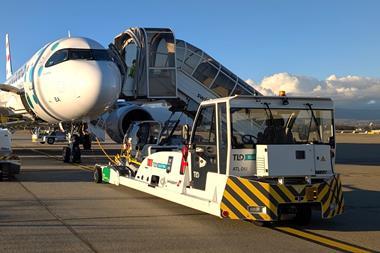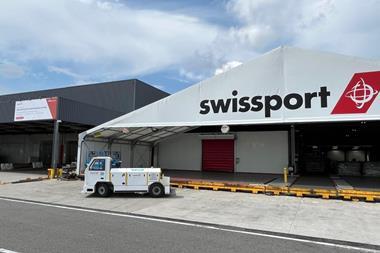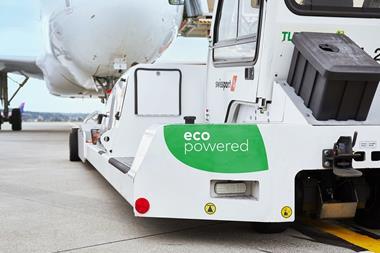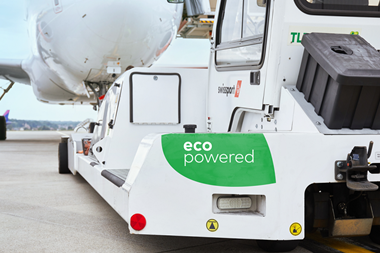





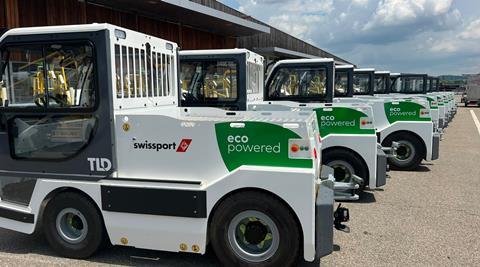
Swissport has declared that 25% of its global ground support equipment (GSE) fleet is now electric as it continues to work on reducing its operational emissions.
As part of its ongoing fleet renewal strategy, Swissport has purchased more than 1,000 new hybrid and electric GSE vehicles over the past 18 months which are being deployed across 28 countries.
The ground handler is investing over €1.5bn in green technology, including electric vehicles and renewable energy, over the next five years to achieve its target of 55% electric GSE by 2032.
From January this year, Swissport has had a rule in place stating that many types of new vehicles can only be ordered in electric versions.
“We are delivering on our sustainability commitments with concrete actions," said Warwick Brady, president and chief executive of Swissport International. “This investment in eco-tech is a decisive step and reflects our industry-leading position on sustainability and innovation.
"Over the next five years we will be building the world’s largest electric GSE fleet. Our strong commitment to clean energy also supports our airline customers’ climate goals by helping to reduce global supply chain emissions.”
Swissport operates the largest GSE fleet in the world, with approximately 14,500 motorised units. The company is the largest purchaser of new electric equipment.
The current rollout raises Swissport’s share of electric GSE to 25% globally, with strong progress in key European hubs and a clear roadmap for continued acceleration, said the company.
All three Swiss airports—Zurich (43%), Basel (51.4%), and Geneva (59.4%)—are on track to reach the 55% electrification benchmark by the end of 2025.
At Amsterdam Airport Schiphol, all Swissport support vehicles have been fully electric since February 2025. Plus, in the UK, Swissport has doubled its eGSE footprint over the past two years across all four London airports—Heathrow, Gatwick, Stansted, and Luton.
The newly deployed units are being introduced in collaboration with top-tier manufacturers under long-term agreements.
These partnerships ensure sustained equipment availability, consistent quality, and optimal operational performance. Swissport is also working closely with airport authorities to facilitate the rollout of supporting infrastructure, including charging stations and power supply optimisation.
Swissport is also committed to advancing renewable energy use across its global air cargo operations as part of its sustainability strategy. Its cargo warehouses in Barcelona and Madrid now run entirely on renewable energy, cutting CO2 emissions by 305 tons annually.
In Nairobi, a 100 KW solar grid installed in 2017 powers 35% to 40% of the energy needs for perishable cold rooms, supporting critical temperature-sensitive logistics with clean energy.
Frankfurt’s warehouse features the largest photovoltaic system at the airport, generating over 1.5m kWh of sustainable solar power each year.
Swissport said in December 2023 it would aim to decarbonise its operations and supply chain to achieve net-zero carbon emissions by 2050.