
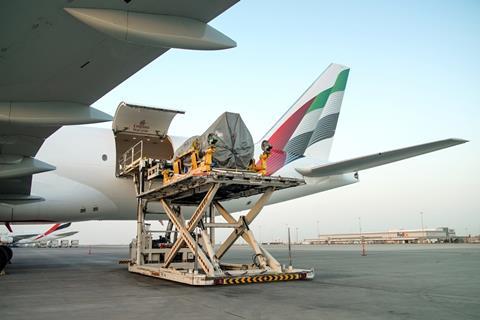
Emirates SkyCargo, the air cargo arm of the Dubai-headquartered Emirates Group, has launched Aircraft Engines, a dedicated offering for the shipment of these high-value and outsize items.
The product forms part of a new vertical within the cargo carrier, Aerospace and Engineering.
Badr Abbas, divisional senior vice president at Emirates SkyCargo, commented: “Moving highly specialised items is always an exciting challenge, and, having significantly invested in building world-class infrastructure across our network, it’s a challenge that we are ready to meet.
“Harnessing the technical expertise of our team, our proprietary and innovative technology and fit-for-purpose infrastructure, we liaised closely with various stakeholders to develop Aircraft Engines and a dedicated product vertical, to ensure we were able to cater to such valuable and technical cargo at every touchpoint.”
Speed and careful handling
Aircraft engines require specialist handling. Transported for maintenance, repair and replacement purposes, there is also often a critical need to move them as quickly as possible.
As part of the new Aircraft Engines product, certified Emirates loadmasters supervise the loading, securing and unloading of engines, managing the end-to-end shipment with the help of specialised handling techniques, checklists and equipment, including shock absorbing transport dollies.
The Emirates control tower team monitors every shipment to ensure delivery as promised, while additional track-and-trace devices can be added to the booking for the provision of real-time updates throughout the entire journey.
Aircraft Engines shipments are moved under the highest loading priority and numerous specialists, located in key cities across the airline’s global network, are available to provide consultation services and support to customers of the product via a dedicated hotline and email address.
Aerospace and Engineering
The new Aerospace and Engineering industry vertical is key to the Emirates SkyCargo strategy to provide tailored logistics and transport solutions to a sector that demands “high precision, specialised handling, and speed”, it said.
The vertical will serve customers in the aviation, engineering, defence and space industries, including: commercial aviation companies, aircraft manufacturers and parts
suppliers transporting components and engines; manufacturers producing satellites and other space technology; engineer teams involved in the development and manufacture of technologies in propulsion, avionics and materials science; and governments requiring the highest levels of security for specialised shipments.
In addition to Aircraft Engines, the vertical includes the Emirates AOG (Aircraft on Ground) product, which handles time-critical aircraft parts.
Emirates SkyCargo already moves multiple shipments of aircraft parts every day, and recently enhanced this offering, introducing new ‘Must Go’ bags stamped with ‘CARGO’ to prompt the highest level of speed and service.
Plus, Emirates SkyCargo has confirmed that additional subcategories within the Aerospace and Engineering vertical are being put together.
Emirates SkyCargo already ships hundreds of engines each year, and has also been involved in significant aerospace movements, including that of the KhalifaSat, the first satellite developed and built by Emirati engineers in the UAE, which flew from Dubai to South Korea.
It also recently transported nanosatellites from Paris in France to Auckland in New Zealand, before they were launched into orbit to provide global Internet of Things connectivity.
New products
Aircraft Engines is not the only new offering that the carrier has launched of late.
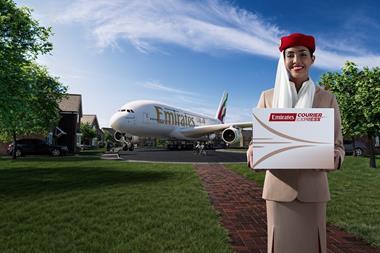
In April, it was revealed that Emirates had launched end-to-end delivery solution Emirates Courier Express, which features what it said is an average delivery time of less than 48 hours.
The airline worked with various global customers to pilot the service, focusing on speed, reliability and flexibility.
As part of the pilot, Emirates Courier Express transported several thousand packages from the UAE, Saudi Arabia, Bahrain, Kuwait, Oman, South Africa and the UK over the previous 12 months.