


The European airframer remains confident with prototype assembly underway in Toulouse and flight testing programme set to commence next year
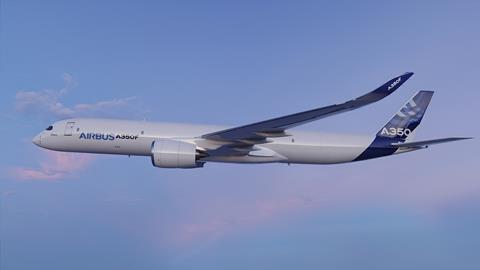
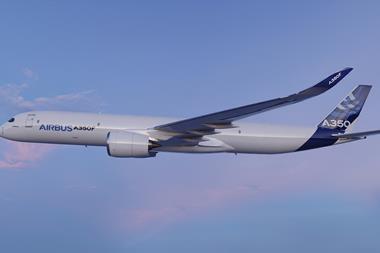
Airbus is on track to deliver its newbuild A350 production freighter in the second half of 2027 and remains confident on customers.
The European aircraft manufacturer has confirmed it is keeping pace with its manufacturing schedule for its anticipated A350F entry to market date.
Speaking to Air Cargo News about the timeline for the A350F, Oliver von Tronchin marketing, said: “We have received all the parts we require to build the first two prototype aeroplanes to do the testing. With that in place now, we are very much on track for certification.”
The two aircraft he refers to will be undergoing flight testing for operational performance throughout 2026 and early 2027 following ground testing of parts for safety, although the engine is already certified with no testing required as it is the same model used on the passenger A350.
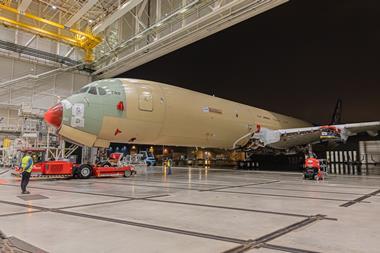
“Final assembly started in Toulouse in the summer,” said von Tronchin. “After that authorities require testing before we can do the first flight. So, the first flight is planned for next year. After the test flight programme is completed there will be certification and then delivery in 2027.”
There is a short timeframe between the first test aircraft being ready and the second one, he added.
While flight testing will be carried out in-house, customer events may take place at certain airports to introduce the A350F to customers, as Airbus, operationally headquartered in France, did for the passenger A350.
While things are reportedly running smoothly, Airbus has of course pushed back the commercial launch of the A350F before.
Firstly, in May 2023, the company adjusted the entry into service date for the A350F from the end of 2025 to the first quarter of 2026.
At the time, chief executive Guillaume Faury had said that the timeline change was a matter of a “few months” and related to overall programme execution.
However, referencing supply chain challenges, he had stressed: “We’re not specifically putting it on the shoulders of one or other supplier.”
Then in February this year, Airbus pushed back the entry-into-service date of the A350F to the second half of 2027.
The airframer stated that it had been facing “specific supply-chain challenges, notably with Spirit AeroSystems”, which are “putting pressure” on ramp-up of A350 production.
Spirit AeroSystems is a supplier of aerostructures to Airbus including the central fuselage section of the A350.
At time of Airbus’ announcement, Spirit was undergoing a restructuring following the decision by Boeing to acquire the company, a process which involved separating its Airbus operations.
But von Tronchin indicates that no further delays caused by supply chain delays affecting parts deliveries are expected.
He reiterated: “We have now received all the critical parts”, adding “yes, the delay was mainly on supply chain issues”.
He further stated there was an issue with “one specific company that is very well reported by the industry, which is Spirit, which produces parts for Airbus and Boeing and for passenger and freighter aeroplanes”
However, he stressed: “We now have received the parts that we need from Spirit for the flight test aircraft.
“So with that we are really safe for our project here, and that is out of the way in terms of holding us back.”
2025 Production milestones
September - Entire fuselage for first A350F delivered to Toulouse, the final assembly line for the cargo twinjet.
August – Airbus received the initial fuselage sections for its A350 freighter, MSN700, at its final assembly line in Toulouse, France.
July - Airbus completed manufacturing the first A350F horizontal stabiliser (HTP) at its plants in Spain.
May - manufacturing of the first set of A350F wings is completed.
April- the first forward fuselage section of the aircraft was equipped with essential systems
March – Delivery of the first section 19 - the aerostructure located aft of the main fuselage barrel and which interfaces with the tail of the aircraft.

Highs and lows
Alongside some challenging periods of production, there have been a few blows to Airbus’ order book recently.
In March, the Air France KLM Group said that it planned to reduce its A350F order from eight units to six, following production delays and a fleet portfolio assessment.
Accordingly, last month one A350F was removed from subsidiary Martinair’s backlog, leaving the Netherlands-based freighter operator with three on order.
Air France will also reduce its order from four to three of the model.
Meanwhile, Air Lease also confirmed in August that it had cancelled its entire order for seven A350Fs. The US lessor had been a launch customer for the freighter in 2021 and had expected to take two aircraft in 2026 and another two in 2027, with the remaining three delivered at a later date.
As well as the delay to market, Air Lease was also mindful of the uncertainty about committing to cargo aircraft in a changeable market subject to geopolitical conflict and tariff turbulence.
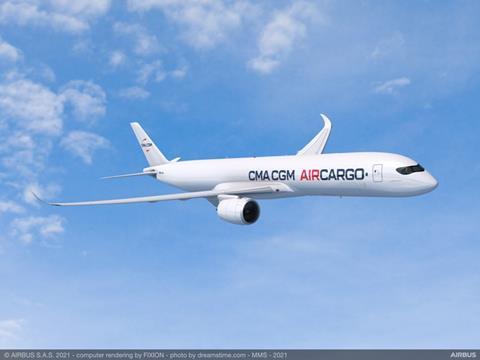
Following Air Lease’s cancellation, CMA GGM became the launch operator for the A350F as it was the second company to sign up for the freighter when it signed a memorandum of understanding (MoU) for four A350Fs in November 2021, firming up the offer the following month.
Airbus also gained some orders mid-year to help soften the blow of the cancellations.
In June, Saudi Arabian aircraft lessor AviLease placed an order for 10 at the Paris Air Show, with an agreement for a potential 12 additional aircraft.
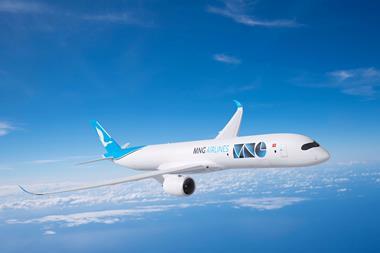
In the same month, Turkey-based MNG Airlines signed a Memorandum of Understanding (MoU) for two aircraft.
The changes mean that there are now 11 customers who have ordered 67 A350Fs. There are a total of eight cancellations, although once Air France officially removes one A350F from its order of four, cancellations will number nine.
While von Tronchin noted stated it’s difficult to predict future, given the current volatile market, this is the stance most airfreight companies have about any business, although Airbus retain a positive outlook.
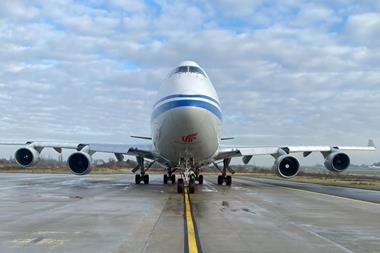
“This year's a very active market. People are really driven by the need for a 747F replacement. They want to place orders because the later you place it, the longer you wait.”
The initial interest was very much driven by the combination carriers, but Silk Way’s order demonstrated interest from cargo carriers and ocean shipping giant CMA CGM’s order shows further diverse interest in the freighter.
One part of the market that might hold potential is the express market. As von Tronchin points out: “There have been no decisions yet on any next generation large freighter from any of the express companies. So that market is still being worked on.”
A350F orders
June 2025: Turkey-based MNG Airlines signs an MoU for 2 A350Fs
June 2025: Lessor AviLease places order for 10 with an agreement in place for a potential of 12 more.
January 2025: Airbus received an order for 3 A350Fs from mystery customer
February 2024 - Starlux Airlines orders 5 A350Fs. Exercises options to additional 5 in January 2025
December 2023: Turkish Airlines orders 5 A350Fs
December 2023: Cathay Cargo orders 6, with the right to order 20 more.
January 2023: Air France-KLM Group orders four A350Fs for operation by Martinair on behalf of KLM Cargo. Order reduced to 3 in August.
December 2021: Air France orders 4 A350Fs - order confirmed in April 2022 – order anticipated to be reduced to 3.
February 2022: Singapore Airlines firmed up an order for 7 A350Fs
June 2022: Silk Way West Airlines ordered 2 of the model
August 2022: Etihad Cargo firmed up an order for 7
November 2021: US lessor Air Lease orders 7 A350Fs – cancellation confirmed August
November 2021: shipping firm CMA CGM ordered 4 for CMA CGM Air Cargo. Order doubles to 8 in April 2024
Conversions holding strong
The A350F makes Airbus present in the large, mid and small freighter segments for the first time ever.
Because in addition to its most famous freighter, the company also has a conversion business experienced in both widebody and narrowbody aircraft, as well as the A330-200 production freighter, which has no current orders or outstanding deliveries - the last delivery of the model was in 2017 to Etihad.
Elbe Flugzeugwerke GmbH (EFW), the joint venture between Airbus and ST Engineering, is busy converting three aircraft types.
EFW’s programmes include the widebody platforms – the A330-200P2F and the A330-300P2F – which were first redelivered in 2017 and 2018 respectively; and the narrowbody platforms – the A321P2F and the A320P2F which were first redelivered in 2020 and 2022 respectively.
EFW has secured A320P2F and A321P2F validations in key regions including Europe, the US, Brazil, Japan, Malaysia, China and India.
The A321P2F offers a payload of more than 28 tonnes, while the A320P2F accommodates more than 21 tonnes.
Meanwhile, the A330-200P2F can carry a gross payload of up to 60 tons of weight to over 7.700 km, while the larger A330-300P2F can carry a gross payload of up to 62 tons and a containerized volume of up to ~18.581ft3 (~526m3).
Speaking about business prospects for EFW, von Tronchin said: “The projections are really good, especially in the mid-size segment, where there is no alternative to the 767, which is stopping production in 2027. Then the conversions will be limited by the very little passenger feedstock left. The A330-200 and 300 P2F will eventually take over from the 767F.
As of the last quarter of 2024, 47 A321P2F, 4 A320P2F and 49 A330P2F converted by EFW had been redelivered.