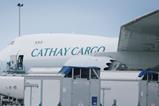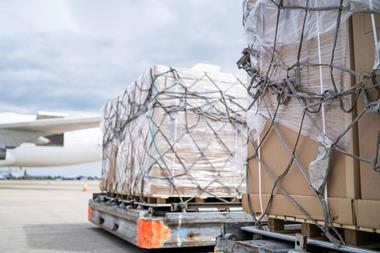




Hong Kong’s Air Accident Investigation Authority’s preliminary report found that one of the engines continued to accelerate after the flight had landed
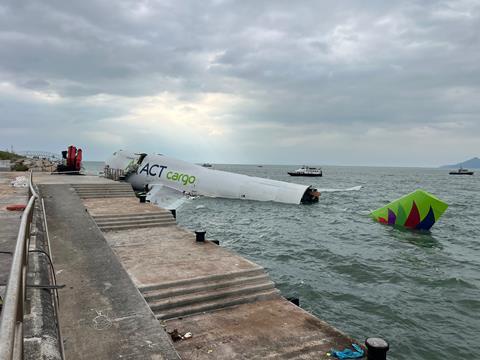
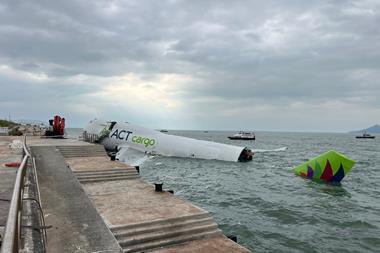
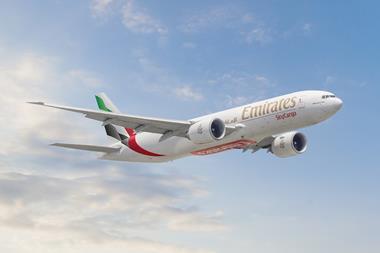
One of the engines on the Boeing 747 freighter, which skidded off the runway and killed two workers at Hong Kong International Airport (HKIA) last month, had accelerated after landing, a preliminary report has found.
The preliminary report of Hong Kong's Air Accident Investigation Authority (AAIA) found that the Number 4 engine on the 747F continued to accelerate after the flight had landed at approximately 3.52am and the aircraft subsequently collided with a stationary security ground vehicle, which resulted in the ground vehicle entering the sea and the death of the two workers in it.
The report on the 20 October incident involving ACT Airlines flight UAE9788 operating from Dubai’s Al-Maktoum International on behalf of Emirates stated: "Number 4 engine accelerated to 90% N1 forward thrust at 03:52:30 hours."
AAIA's report further added: "Number 4 engine continued to accelerate to approximately 106% N1 forward thrust at 03:52:36 hours and ended up at 107% N1 at 03:52:42 hours." The Number 4 engine thrust reverser was also inoperative, according to the report, although this was allowed under aviation rules.
An autobrake landing was planned; however, the report found the autobrake selector was indicating disarmed, and the captain took over the control of the aircraft from the co-pilot.
At the time of the accident, the weather conditions were reportedly suitable for aircraft operation and the aircraft was cleared to land by Air Traffic Control (ATC).
ATC also advised the crew on the wind direction and instructed the four crew, all of which survived the incident, to keep the speed of the aircraft up after landing until the runway had been vacated.
In the course of the runway excursion, the 747F destroyed various airport meteorological sensor arrays, signage, the ground vehicle and a section of the perimeter fence, which it continued through before entering the sea.
The aircraft was destroyed and the tail section separated from the aircraft during the impact sequence.