

Improved output from Boeing and Airbus cannot offset engine shortages that leave new aircraft grounded and conversion feedstock scarce

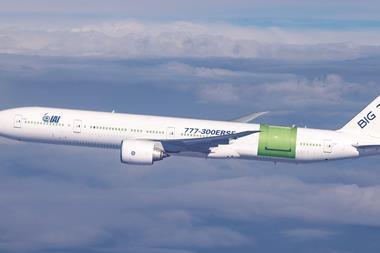
The test flight of the 777-300ER. Photo: IAI
First the good news of recent months: Aircraft production rates have increased and the Boeing 777 has entered the ranks of aircraft models eligible for conversion into freighters. Do these developments augur a stronger industry in 2026?
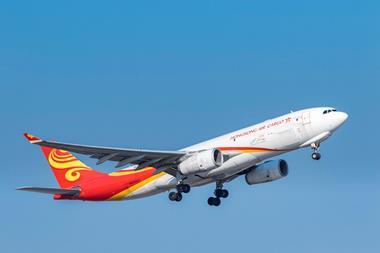
While output from Boeing and Airbus has improved, it is still in relatively low gear, owing to a combination of factors.
The biggest brake on the system is the shortage of engines, which has produced rows of brand-new planes parked while waiting for engines.
Fragile supply chains are hampering aircraft production, and increased military spending means that civil aircraft development and production is facing increasing competition for resources.
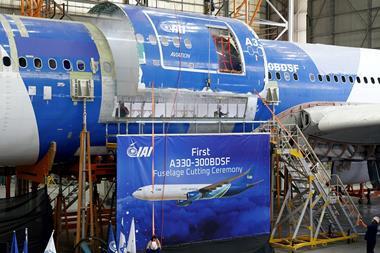
While IAI’s 777 conversion programme is running and the Mammoth Freighter version is expected to soon obtain certification, the feedstock situation points to a mere trickle of converted 777s entering cargo service in the near future.
Delays in the B777X development, which pushed the expected market entry of the 777-8F back to 2029, have forced airlines to keep ageing planes longer in passenger service – even to the point of refurbishment of cabins.
Again the engine bottleneck is aggravating the shortage of conversion candidates and adding to the hefty price tags of available feedstock, with the cost of a GE90 engine used on the 777 shooting up 69%.
According to IBA, the half-life value of the 777-300ER has soared 78% to around $47.6m, up from the 2022 trough of $26.7m in 2022.
According to IATA, the structural mismatch between aircraft demand and production capacity is unlikely to level out before the 2031-2024 window.
The order backlog has surpassed 17,000 planes – which equals nearly 60% of the current active fleet, and delivery shortfalls have grown to at least 5,300 aircraft.
As a result, the average fleet age has risen to 12.8 years in the passenger sector and 19.6 years for cargo aircraft.
Inevitably, this is taking a toll on airline costs. IATA estimates that maintenance costs in 2025 were up $3.1bn, engine leasing costs jumped $2.6bn and the cost associated with larger inventories of spare parts expanded by $1.4bn.
The biggest hit came from extra fuel to run older planes, which added a whopping $4.2bn to collective airline costs.
As the industry limps into 2026, it hopes that creaky air traffic control systems will not hobble it any further.