


Cargo airline plans to add one aircraft per year through 2030, reaching a 16-aircraft fleet while preparing for the 2027 opening of new Azerbaijan cargo hub
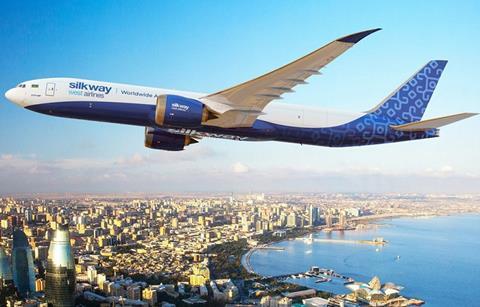
Cargo airline Silk Way West is adopting a conservative approach to fleet additions as it looks to modernise its fleet and prepare for the opening of Azerbaijan’s new cargo airport.
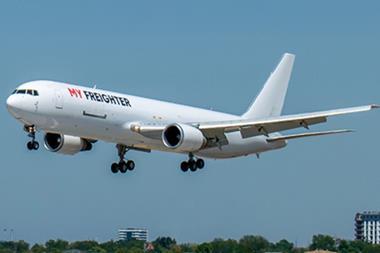
Speaking at the Caspian Air Cargo Summit, Wolfgang Meier, president and chief executive of Silk Way West Airlines, said that the carrier had at the end of August taken delivery of its latest Boeing 777 freighter as part of its fleet renewal programme.
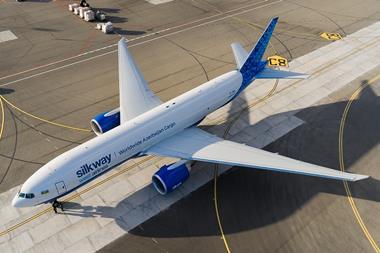
The addition brings the carrier’s current fleet to four 777Fs, five 747-8Fs and four 747-400Fs. The airline has also an outstanding order for a further two 777Fs due to arrive in 2026/2027.
The carrier has also placed orders for four Airbus A350Fs (two of these are options) due to start being delivered in 2028 and four Boeing 777-8Fs (two are options) that should start arriving in 2029.
Meier said that the airline would jettison its three 747-400Fs by 2028 as it looks to carefully manage its overall fleet size.
”We are applying a very conservative growth strategy,” said Meier. “We are going to have net one new aircraft per year, which is conservative growth. [For the strategy] we looked at Cargolux; they have grown in the same manner, and we are applying the same kind of strategy by not growing too fast in order to secure the profitability of our operation.”
By 2030, the airline’s fleet should total 16 aircraft according to current plans: two 777-8Fs, three A350Fs, six 777Fs and five 747-8Fs, which would represent an increase of one aircraft per year over the next five years.
Meier added that the airline’s second future strategy pillar is the development of the new cargo airport as part of the ALAT Free Economic Zone development.
The airport aims to develop Azerbaijan into one of Central Asia’s main logistics centres when it opens in the first quarter of 2027.
Meier explained that the airline is hoping to capitalise on its geographical position on the Silk Road, or middle corridor, as the region looks to develop as an alternative to the northern land corridor from Asia to Europe through Russia and the southern shipping corridor.
Proponents of the central corridor suggest its importance is growing, given the geopolitical tensions along the other routes. Most recently, Poland closed its land border with Belarus, impacting rail operations from Asia.
Meanwhile, the majority of ocean operations are still avoiding the Red Sea/Suez Canal route due to the threat of missile attacks.
"It is very unique that an airline has decided to build a cargo airport in a free trade zone,” said Meier. "Normally, this is done through the authorities, but here we have taken on the ambitious task of building this airport to form a new gateway around the middle corridor.”
"The middle corridor has always been a kind of stepchild corridor. You have the northern corridor through Russia, you have the southern corridor through the ocean and the middle corridor along the acient silk road has always been considered, but it has not really been utilised. Now, is the time to utilise this corridor.
"There are all kinds of infrastructure projects along the Silk Road and, here in Baku, we want to build up a multimodal hub and the ALAT Free Economic zone."
The airport will have an annual cargo handling capacity of 500,000 tons, with further gradual increases in capacity to reach an annual 1.5m tons. The airport is located close to the sea port of Baku and is about 65 km away from the city.
As well as Silk Way cargo facilities, the airport will also have a logistics and cargo handling area that can be utilised by other airlines, freight forwarders, express and e-commerce companies. Its runway measures 4,000 m and the development will look to minimise its environmental footprint.
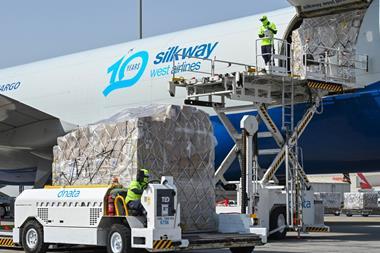
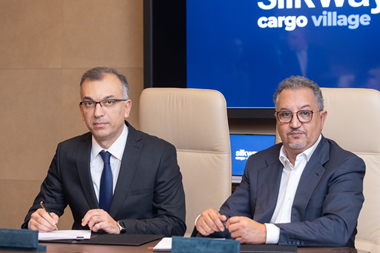
At the event, it was also announced that dnata had been awarded the contract to provide cargo and aircraft handling services at the airport.