

Vice president Raoul Sreenivasan says Amazon Air Cargo has evolved from opportunistic beginnings to a core business
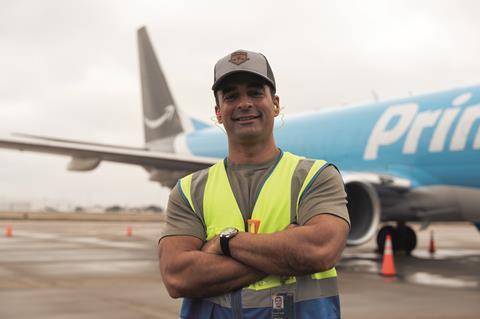
It has now been just over 12 months since Amazon Air confirmed the launch of services for third parties through its Amazon Air Cargo business, a development many in the industry had expected for some time.
Speaking to Air Cargo News, vice president of Amazon Global Air, Raoul Sreenivasan, says the decision to launch Amazon Air Cargo was not a single moment of strategy but the result of serving external customers informally before the public launch.
He explains that the company had begun flying shipments for a customer that had been impressed with the speed, reliability and transparency on offer and the initiative grew quickly from there.
“It started opportunistically and caught on very fast. Customers really liked it,” says Sreenivasan.
Service levels
He adds that customer feedback has remained positive, reflected in Amazon Air Cargo’s customer satisfaction score of 4.75 out of 5. He notes that customers consistently cite the company’s strong service levels.
“While it started opportunistically, we learned that there was a clear demand for the value proposition we can offer, and it has expanded into a business we are excited about,” he says.
Sreenivasan brings long experience of industry transformation, having been part of the TNT team during its takeover by FedEx and having previously worked in liner shipping and DHL.
One ongoing challenge since launch, he says, has been addressing the perception among some shippers that their cargo might be bumped in favour of Amazon’s own e-commerce volumes during peak periods.
Sreenivasan says this remains the number one question from prospective customers.
To address it, the company has created clear communications highlighting its no-bumping guarantee, which assures that once a customer books space, the cargo flies as booked.
To help new customers trial the service, Amazon has also introduced a money-back guarantee, which is separate from a no-bumping commitment.
“We now have a money-back guarantee for new customers and if we do not achieve our prescribed service commitments, we will give them their money back.”
“We now have a money-back guarantee for new customers and if we do not achieve our prescribed service commitments, we will give them their money back,” says Sreenivasan.
Under the scheme, eligible new customers may receive reimbursement of up to $10,000 per flight if a shipment arrives more than two hours late due to an Amazon service failure.
He adds that Amazon Air has also developed a system that reserves space immediately upon booking.
Overall, Sreenivasan says Amazon Air Cargo has been a success.
“Since our official launch last year, we have doubled our customer base,” he points out. “It is still relatively small, but we are seeing customers buy into the value proposition. For us, it is no longer a side project. It is part of our core business and we will continue to invest in it.”
Digital booking
One current area of investment is a digital booking and quoting tool developed in-house, which Sreenivasan describes as an example of Amazon’s commitment to strengthening its cargo offering.
A separate question for Amazon is the annual peak season. Sreenivasan notes that peak periods are such a defining part of the company that employees often measure their tenure by the number of peak seasons they have experienced rather than by years.
From a cargo perspective, he says Amazon prepares by expanding capacity ahead of peak.
“We do several things. When we increase our fleet throughout the year, we time additions so that maximum capacity is available for the peak season,” he says.
“We also plan our maintenance schedules across the year so that the largest possible fleet is available in November and December. And we adjust our network design. In November, for example, we moved to our peak schedule, which utilises aircraft at a higher level.”
This year, for instance, Sun Country Airlines completed the full deployment of its fleet of 20 Boeing 737-800 freighters on behalf of Amazon.
Another area of investment is international expansion. Sreenivasan says Latin America has been the “big growth story” of the year, exceeding expectations.
Demand between Europe and nearby regions, as well as flows to and from the Indian subcontinent, have also been strong.
Regarding cross-border operations, Amazon does not sign interline agreements because it is not an airline. Instead, it signs Air Transportation Agreements with air carrier partners, while encouraging those partners to interline with other airlines where useful.
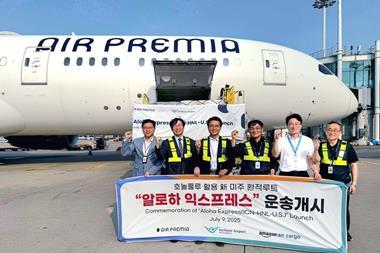
This year, Amazon Air Cargo has expanded international operations through several carrier collaborations.
These include a collaboration with Avianca for a daily Boeing 767-300 freighter operation between Miami and Bogotá, adding capacity between North and South America.
Amazon has also expanded its presence in the Caribbean through agreements with ALK Global Logistics and Aerodom on services to the Dominican Republic.
Sreenivasan says further international collaborations are likely as the business grows.
Network planning is a central focus for Amazon Air. Asked whether new routes are driven by Amazon’s e-commerce flows or cargo customer needs, he says both are considered.
“By virtue of scale, Amazon’s retail volumes have an outsized influence on the network. But we load both Amazon flows and Amazon Air Cargo flows into an in-house network design tool that identifies the most optimal combined network.”
“By virtue of scale, Amazon’s retail volumes have an outsized influence on the network. But we load both Amazon flows and Amazon Air Cargo flows into an in-house network design tool that identifies the most optimal combined network,” he explains.
“It is not that one gets preference. We put them together and design a single optimal network.”
He adds that the presence of Amazon’s large e-commerce network is a differentiator for cargo customers, providing the scale and resilience of a large network supported by the fleet and technology tools.
The network uses a hybrid of hub-and-spoke consolidation and point-to-point flying on busier lanes.
Sreenivasan notes that Amazon uses advanced network planning tools, allowing the company to evolve its network quickly.

Source: Kirkam/Shutterstock.com
“Every time we bring in a new air cargo customer, we evolve our network design, so customers do not have to fit into a standard pattern,” he says.
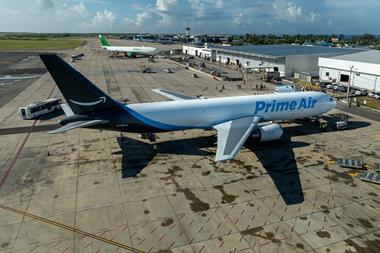
Amazon’s fleet comprises more than 100 aircraft, operating more than 250 daily flights across 65 destinations, seven days a week, through its air carrier partners.
The company has been adding Airbus A330-300 freighters as part of a fleet-modernisation effort.
The A330Fs provide greater capacity, improved emissions performance, lower unit costs and extended range.
Strong performance
Sreenivasan emphasises that this does not diminish the role of the 767F, which continues to perform strongly and remains the backbone of the operation.
The increased range of the A330F has supported expanded operations in Latin America.
On the potential addition of larger widebody freighters for intercontinental operations, Sreenivasan declines to comment on speculation.
“But I will say that all our fleet decisions are based on customer needs. We will make future decisions based on customer needs, and with that, everything is on the table.”
He adds that the company expects to add more 767Fs and more A330Fs, including younger 767Fs to replace older units where appropriate.
Research from the Chaddick Institute at DePaul University has suggested Amazon has reduced some short-haul flying as larger aircraft enter service and trucks take on more domestic movements.
Sreenivasan stresses that network developments are driven by customer needs rather than a push to reduce short-haul flying.
“It is a conscious decision to invest where our customers need us. The trends observed by the researchers align with customer demand and our introduction of larger aircraft,” he says.
“Everything we do is based on working backwards from the customers’ [requirements],” he concludes.