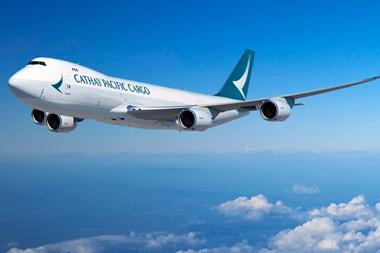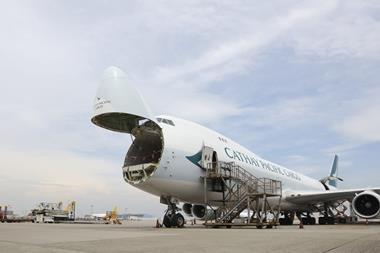





Dominic Perret's first leadership message highlights network flexibility and Madrid freighter expansion as the carrier navigates changing market dynamics

In his first leadership message, Cathay Pacific’s new cargo director, Dominic Perret, has highlighted a solid peak season and the airline’s network flexibility.
Writing in the company’s monthly update, Perret said that the cargo peak season had been stronger than anticipated despite uncertainty and the US decision to end the de minimis exemption that had enabled duty-free imports of e-commerce goods.
"For the time being, we’re in a solid peak period. It’s not exceptional, but it is stronger than anticipated. There are good load factors out of Hong Kong, and despite the impact of policy changes on e-commerce flows, our transpacific loads are also encouraging.
"Where opportunities arise, we’ve been leveraging our strong global network to pivot and add capacity elsewhere. The question is, what will the market look like in February? Regardless of the outcome, we have the team, the network and the solutions in place to deliver for our customers."
Figures for October show that cargo tonnes are up 6.4% year on year, while the load factor is down 1.2 percentage points to 60.3%.
As well as benefitting from winter bellyhold services to the southern hemisphere, Perret also highlighted recent freighter network changes to adjust to changing market conditions.
"We’ve also added Madrid as a stop for our European freighters, as more products from the e-commerce giants find their way to this market," he said.
"We know that the Asia Pacific to Europe market is extremely competitive, but our additional capacity reflects our confidence that we have an important role to play here and that our reliable, high-quality service will add real value for our business partners."
The Madrid freighters have been "almost full to capacity", according to Anand Yedery, recently appointed regional cargo manager, Europe.
Yedery’s role is to smooth out the directional imbalance created as e-commerce imports surge.
The carrier will use Europe as a transit point for South American perishables to Asia, especially salmon and fruit.
The cargo team has used ports in Spain, as well as Amsterdam and London, to channel these shipments carried by interline partners, he explained.