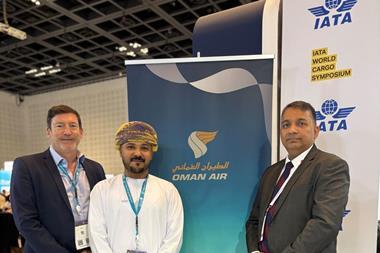




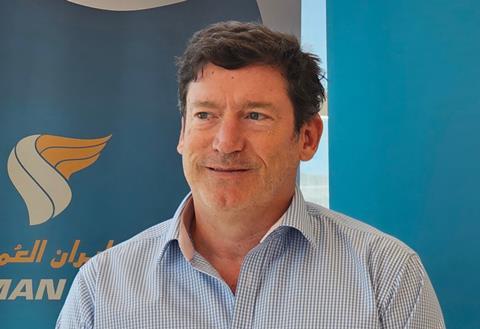
Mike Duggan has been focusing on driving efficiencies at Oman Air Cargo since joining the airline one year ago and is now considering widebody freighter capacity options.
Mike Duggan joined Oman Air one year ago to head up the cargo business as the airline was in the midst of a restructuring effort that aimed to tackle a loss-making financial performance.
The restructuring would see the airline slim down its fleet to a single widebody aircraft type and focus on its core routes.
Duggan, who has worked in air cargo and aviation since the early 1990s, holding roles at DHL and Emirates amongst others, tells Air Cargo News that his initial focus when joining the airline was getting to know the team, customers, network, business challenges and processes.
“The usual sort of things, not trying to wave the magic wand,” he says.
“The company is going through a form of transformation where we have had to look at top-to-bottom efficiencies, process change, business planning and network development.
“This is both on the passenger side and, of course, that impacts the cargo side because that is where we are steered from.”
One of the tasks facing Oman’s capacity team is to significantly increase fleet utilisation.
“That has meant slightly different routings, and before I joined a year ago, the company got rid of half of its widebody passenger capacity as part of the efficiency drive.
“That has meant deploying narrowbody new technology, such as Boeing 737 Max aircraft, onto those routes previously operated by older widebodies.
“So, there has been a network re-adjustment as well as an aircraft deployment adjustment.”
In terms of the cargo business, Duggan says the airline has a network covering Asia, Europe, the Middle East and the Indian subcontinent, as well as a series of partnerships to further extend the offering.
The Asia/Indian subcontinent-Europe lanes form the main basis of the cargo business, with shipments hubbing through Muscat.
However, the airline also carries around 70% of the cargo being flown into Oman and some exports, which are largely perishables.
Amsterdam capacity push
The biggest development in network terms over the past few months has been the carrier’s decision to add four-times-weekly Boeing 787-9 flights from Muscat to Amsterdam.
The new service will offer 14-18 tonnes of cargo capacity per flight in each direction.
This winter, the airline will also increase its flights to Heathrow to 11 per week from daily, with the eventual aim of going double-daily in 2026.
“Amsterdam is a great destination for our cargo network and will give us some really good high quality origin cargo out of Asia,” explains Duggan.
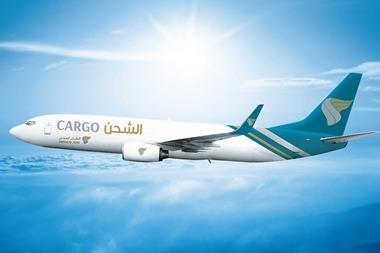
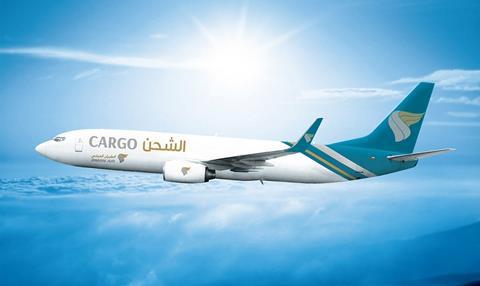
As well as the passenger fleet, Oman Air also operates a single narrowbody freighter.
Duggan says the freighter operation provides strategic lift out of India and Bangladesh, where its narrowbody passenger aircraft don’t provide quite enough capacity to meet demand requirements.
Until May, the aircraft was an Oman Air-owned Boeing 737-800 with 24 tonnes of capacity. However, in the middle of the month, the operation was outsourced.
“Oman Air remains 100% committed to operating significant freighter capacity,” the airline says in a statement.
“Oman Air is moving from an insourced freighter model to an outsourced model and has therefore sold B737-800F A40-BU .
“Oman Air Cargo will continue its strategy to offer maindeck feeder capacity for its passenger belly network, to/from the Indian sub-continent.”
Duggan says he is hoping to expand freighter capacity further in the future, although the plans are “still taking shape”.
“I am looking at widebody freighters, either as a dedicated programme or what we can do with partners through joint ventures or block space agreements.
“We would use that to feed and de-feed our passenger network, as we have a little bit of a bottleneck from east to west.
“That extra capacity would help alleviate that bottleneck and give our customers in Asia the ability to use our network a bit better.”
Duggan adds that having control of freighter capacity also helps the cargo business capitalise on emerging demand streams.
For instance, he says, the carrier ramped up its freighter operation into Bangladesh when there was a boom in demand out of the country last year.
“Airlines are becoming more agile, and they have to be, and that is 1,000% the case in freighters.”
While Oman Air’s network might be smaller than that of some of its Middle East rivals, Duggan says it makes up for this with high-quality service levels.
He points out that Muscat airport and Oman Air’s cargo facility have plenty of spare capacity, while the latter is also relatively new, having been completed in 2018.
The cargo facility features a 22,780 sq m, air-conditioned warehouse with the capacity to handle 350,000 tons of cargo per annum.
The facility has bulk cold rooms, ULD cold rooms, an animal centre, a dangerous goods room, a vulnerable goods cage, a human remains room, a radioactive room and a strong room.
“What we may lack in size, we make up for in quality of service and our customers recognise that and they come back to us regularly,” Duggan says.
“They know what they are going to get from us, and they know the standard of service. We have a lot of loyalty from the customers that work with us.”
Duggan adds that the high level of service that Oman Air offers also helps the carrier garner “slightly higher yields”.
Stable trade?
On current market conditions, Duggan says that the nature of Oman Air’s network should protect it somewhat from the trade turmoil that has been instigated by the US government’s wide-ranging tariff push as it looks to reduce trade deficits and increase US manufacturing.
He says that Oman Air’s trunk routes are “always busy”, while demand to Middle East and Gulf Cooperation Council members is “a little more varied” with some spare capacity.
However, the China-US trade dispute could still have an impact if demand on the transpacific trade lane declines as a result of the tariffs and carriers move capacity to Asia-Europe where Oman Air is active.
However, Duggan thinks that the trade war may not have as much of an impact on the market as some market commentators fear.
He explains that concerns around the impact of increasing US regulations and tariffs targeting e-commerce could prove unfounded as consumers’ buying habits are now formed around online shopping.
Meanwhile, he adds it will also be difficult for the US to recreate the manufacturing capability of China, meaning goods will still need to be produced abroad.
Looking ahead, Duggan says his focus will continue on creating and sustaining the efficiencies gained.
He adds that there could be some further network tweaks, but “probably in 2026, we will be pretty much as we are”.
“Fleet expansion isn’t planned for another year or two,” he says. “For now, we are happy to consolidate what we have got and sweat our assets more strongly and gain efficiencies.
“We are looking at our longer term plans, but nothing is agreed or set out.”