


German logistics giant reports airfreight volumes down just 0.2% to 444,000 tons in third quarter, but revenue has declined

DHL’s airfreight revenue fell in the third quarter of the year, although volumes only dropped slightly in comparison.
The German logistics company reported that airfreight volumes amounted to 444,000 tons in the third quarter, down 0.2% on the 445,000 tons recorded in the third quarter of 2024. DHL said it saw "largely unchanged volume momentum vs. Q2".
In comparison, Kuehne+Nagel's (K+N) airfreight volumes were up 7.2%, and DSV's grew by 64%, following the acquisition of Schenker.
Meanwhile, airfreight revenue in the Global Forwarding, Freight (GFF) division fell by 7% year on year to €1.5bn year on year. However, gross profit rose by 5.9%.
Total first quarter revenue in the GFF division decreased by 9.2% to €4.6bn in the third quarter of 2025 due to lower freight rates. EBIT (Earnings Before Interest and Taxes) in the GFF division declined by 29.6%.
"Volume growth in 2025 is being impacted by the systematic withdrawal from the transport of high-volume, low-yield business," commented DHL.
"The lack of volume recovery in air freight, declining ocean freight rates, and continued economic weakness in Europe led to a decrease in revenue and earnings at DHL Global Forwarding, Freight in the third quarter," said DHL.
Group revenue declined 2.3% to €20.1bn due to currency effects, said DHL. But DHL said that by combining active capacity management, structural cost improvements, and price adjustments, the Group increased its operating profit (EBIT) by 7.6% to €1.5bn.
The Group noted that new import rules for low-value shipments to the US, previously covered by the de minimis exemption, are so far having only a limited impact on earnings, though in the Express division, shipment volumes to the US have declined due to the removal of de minimis and the imposition of higher tariffs, leading to lower revenue and consequently also impacting season surcharges and market-based pricing.
"However, this also creates an opportunity to grow on trade lanes with underutilized capacity and improve network imbalance," said DHL.
The Group added: "Given the ongoing decline in volumes, we are also working to maintain yield discipline. We are concentrating on cost savings and volume adjustments in our air network. We are also continuously improving productivity in ground operations and at hubs. These measures represent an opportunity of medium significance to us."
Tobias Meyer, chief executive at DHL Group, said: "Despite the volatile environment, we improved our earnings four consecutive quarters. This is the result of our active capacity management and structural cost improvements. Thanks to this resilience, we can continue to invest in quality for our customers and in growth markets. We are well prepared for the seasonally strong year-end business.”
The Group confirmed it is continuing to invest in Asia, the Middle East, and Africa, as well as in life sciences and healthcare logistics.
In September, the Group announced the acquisition of the US pharmaceutical logistics provider SDS Rx to strengthen its pharma logistics services.
As part of its Strategy 2030 and the 'Fit for Growth' programme, DHL Group is also investing in digitalisation, including the increased usage of AI agents and robots, as well as the expansion of its parcel locker network.
To help it prosper in a volatile market, the Group said it had undertaken capacity management and cost improvement measures. For example, DHL Express reduced its aviation costs year over year by 8.5%.
In anticipation of the year-end peak, DHL Group expects a typical seasonal increase in e-commerce deliveries to consumers in the fourth quarter.
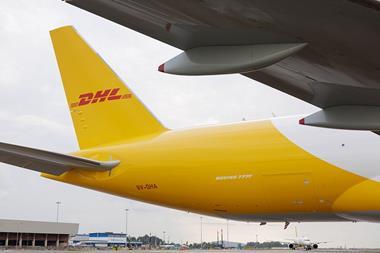
The Express business plans to temporarily deploy 10 additional Boeing 777 freighters on heavily frequented routes.