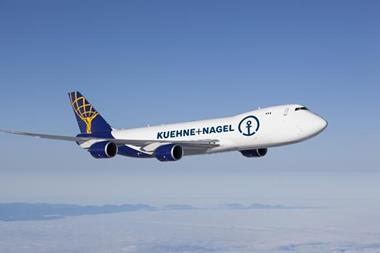






© 2024 Kuehne+Nagel. All rights reserved
Kuehne+Nagel (K+N) retained its position as the top airfreight forwarder last year as the market grew at a rapid rate, led by the e-commerce sector (see full chart at the end of the article).
Figures provided by consultant Armstrong and Associates show that K+N saw its airfreight volumes increase by 5.5% last year to 2.1m tonnes despite what it described as challenging market conditions.
“In 2024, the market was characterised by highly volatile demand for air transport services, whereby the market has turned towards strong demand for export capacities out of China from e-commerce customers,” the company said in its annual report.
Last year was a bounce-back year for the forwarding market after registering large declines in 2023 as a result of a decline in consumer spending caused by inflation and modal shift back to ocean after the logjam issues experienced by box shipping in 2021/2022.
The air forwarding market also benefited hugely last year from difficulties in ocean shipping as a result of Houthi missile attacks on vessels transiting the Red Sea.
Following the attacks, container shipping lines began sailing around the southern tip of Africa, which extended transit times by weeks, increased costs and resulted in disruption to shipping services.
K+N also benefitted from the performance of its Asia-based Apex Logistics business and on the back of perishable demand and its Apex Logistics business.
However, profits came under pressure as airfreight rates continued to narrow from the Covid highs caused by a lack of passenger flights.
Yields in aerospace and pharma/healthcare were better than in other parts of the business.
2024 was also a busy year for second-place DHL Global Forwarding, which saw air cargo demand grow by 6.8% to 1.8m tonnes.
DHL said that its growth was primarily on trade lanes from Asia and Europe.
“The global forwarding market in 2024 was characterised by capacity constraints as a result of the disruption in the Red Sea and by ongoing geopolitical conflicts, particularly in Ukraine and the Middle East,” the forwarder said.
“Higher demand, particularly in e-commerce, and limited capacity caused freight rates in air and ocean freight to rise over the course of 2024.”
Of the top three airfreight forwarders, Denmark-based DSV was the fastest grower as its volumes increased by 7.1% year on year to 1.4m tonnes.
DSV said that demand was positively impacted by a macroeconomic uptrend and an increase in consumer spending, especially in the US, in combination with some pre-loading ahead of a potential implementation of new US tariffs in 2025.
“The positive volume trend was most significant for airfreight, driven by significant growth in e-commerce volumes from China,” DSV said.
“The demand for air freight was also positively impacted by an increase in conversions from sea to air shipments, driven by the narrowed price gap between airfreight and sea freight, disruptions related to the Red Sea situation and risk of strikes on the US East and Gulf coasts.”
The forwarder added that during the year, airfreight capacity continued to recover as bellyhold operations picked up following the Covid pandemic.
The performance at the top three was a little behind the performance across the top 25, with Armstrong and Associates figures showing an increase of 9.4% as growth at Asia-based companies generally outpaced that of the rest of the market.
Fast growers
The company that reported the highest growth rate last year was CMA CGM-owned CEVA Logistics, which saw its airfreight volumes increase by 66.7% year on year to 750,000 tonnes.
As well as benefiting from the overall market improvement, the France-based logistics company was boosted by the acquisition of Bolloré Logistics.
In 2023, before the takeover, Bolloré Logistics recorded airfreight volumes of 350,000 tonnes while CEVA noted a total of 450,000 tonnes.
Elsewhere, Asia Pacific-based companies tended to outperform those of other markets.
For instance, Sinotrans registered a 14% increase in airfreight volumes, Nippon Express was up 32.9%, AWOT Global increased by 32.2%, KLN was up 31.9%, CTS International improved by 26%, Best Services was up 31.7%, Morrison Express jumped 17.2% and Yusen grew 17%.
This is likely down to the later recovery from the Covid pandemic in Asian countries, while these forwarders would have been best positioned to capitalise on the surge in e-commerce demand during the year.
Nippon Express also benefited from the acquisition of cargo-partner at the start of 2024. In 2023, Nippon Express handled 693,546 tonnes of airfreight while cargo-partner’s volumes stood at 243,533 tonnes.
US companies – not owned by express firms – also outperformed their European rivals with volumes at Expeditors increasing by 12%, CH Robinson 17% and Crane 12.2%.
In its fourth quarter update, Expeditors said that growth had been driven by “strong demand from Asia, along with heavy de minimis-driven e-commerce business and increased demand for technology products”.
CH Robinson also spoke of “elevated e-commerce export demand from Asia during much of 2024”.
2025 outlook
There could well be a big change at the top of the table for this year as a result of the mega-merger between third and fourth-placed DSV and DB Schenker.
The acquisition of Schenker by DSV will, based on 2024 numbers, create a new forwarding giant with airfreight volumes of 2.4m tonnes.
However, there will, of course, be some volumes lost as some shippers will no doubt look to move volumes away from DSV to avoid having all their eggs in one basket.
Also, the acquisition was not completed until April, meaning that volumes over the first three-plus months of the year may not be included in DSV’s full-year figures.
The release of second-quarter figures should provide a clearer picture of how the year will end up.
Meanwhile, K+N seems keen to re-establish itself at the top of the table.
At an investor event held earlier this year, Yngve Ruud, executive vice president, air logistics, said the company was confident it would regain the top spot based on ‘bolt-on’ acquisitions to expand in specific sectors and organic growth.
“Scale matters,” Ruud said. “Historically, our growth and investment led us to the number position in 2021 and we have successfully defended that position through to today. If we are surpassed for a brief period of time in the near future, we firmly believe we will regain that leading position.”
Growth will be fuelled by investment in services for specific sectors, such as aerospace, semiconductors, server & data centres, healthcare, and perishables; the expansion of its charter network and gateways to allow it to adapt to changing patterns of trade; investments in people and technology; and bolt-on acquisitions.
On the demand front, airfreight volumes have held up surprisingly well so far this year despite the US implementing a range of tariffs, at one point reaching 145% for China before settling back to 30%, and removing the de minimis exemption for e-commerce packages from China.
The exemption had allowed e-commerce packages worth less than $800 to enter the country duty-free and with minimal customs scrutiny. Packages are now subject to the same 30% tariff as other cargo types.
Despite the trade turmoil, figures from IATA show that air cargo demand over the first five months of the year increased 3.2% year on year as the industry benefited from a wave of front-loading as tariffs were implemented and then paused.