
Partnerships and stakeholder engagement are essential to sustainable aviation fuel (SAF) adoption throughout the air cargo supply chain.
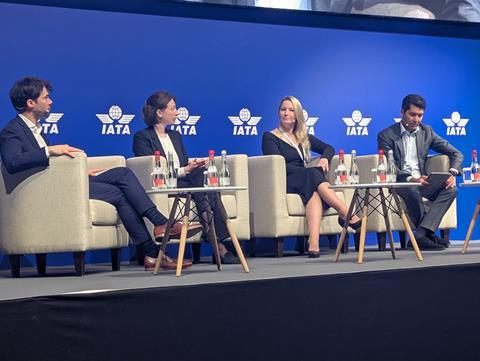
The industry has tough net zero emissions-related SAF adoption targets to meet and working collaboratively on fuel procurement and investment is crucial to increase SAF usage, agreed a sustainability panel duringt IATA's 2025 World Cargo Symposium (WCS).
Helene Goury, sustainability manager at Air France KLM Martinair Cargo said that AFKLM aims to reach 10% of SAF in its fuel usage by 2030.
The business currently has around 1.25% SAF fuel usage, which is three times the industry average.
Partnerships aided this SAF adoption and other sustainability initiatives within the airline, said Goury. In fact, the group has major partnerships with DG Fuels, Neste and TotalEnergies.
“It’s collaboration. Air France KLM has looked into investments since 2023. For example, we invested $4.7bn into DG Fuels (into its Sustainable Aviation Fuel (SAF) production plant in the US).”
She added: “We also did a partnership with Neste to try 100% of SAF into (aircraft) engines. That was successfully demonstrating the positive use of SAF.
“More recently we collaborated with TotalEnergies, which will supply up to 1.5m tons of SAF over a 10-year period.”
Additionally, she added that Air France KLM was working with partners to invest in an e-SAF plant.
Finnair Cargo has also been partnering with Neste since 2020 and Janike Heimonen, sales and sustainability manager at Finnair Cargo simply stressed: “Partnerships are important for SAF.”
She said that collaboration is also important in ascertaining cutomers’ awareness of SAF and its value to them and further, how to support them in uptake of the fuel.
“It’s all about the collaboration between the whole value chain,” she said.
From the perspective of a customer, Kintesu World Express is focused on robust relationships with airlines, credibility and transparency of SAF, price and information sharing.
In alignment with this, shippers are more interested in SAF, declared Frederik van de Ven, director of sustainability (EMEA) and lead supply chain sustainability (Global) at Kintesu.
“Shippers are more committed to SAF you see that SAF price per kilo is being asked about in RFQs," he commented.
That said, he added there is still clearly a lack of proactive action amongst customers in SAF adoption.
SAF supply challenge
During the SAF panel, McKinsey & Company’s Soufiane Daher illustrated how far the aviation and fuel industries have to go with uptake of the fuel. He said the aviation industry used about 1.5m tonnes of SAF last year, but this was only 0.5% of total jet fuel demand.
Regulated demand in the EU and UK alone is 4-5m tonnes. Adding in targeted demand, including the US, takes this figure to 16m tonnes. On top of this, voluntary airline commitments brings the total to over 20m tonnes.
The company’s research also found that expected supply from announced projects will amount to more than 25m tonnes.
“However, not all of these projects will materialise. In fact, we believe that less than 10m tonnes of that will materialise by 2030.”
This shortfall relates to technology and financial issues, said Daher, but while SAF supply is below what’s needed long-term targets are getting higher.
Survey research shared by McKinsey shows shortages are expected until 2030 and more than 60% of buyers expect a SAF supply constraint within the next five years.