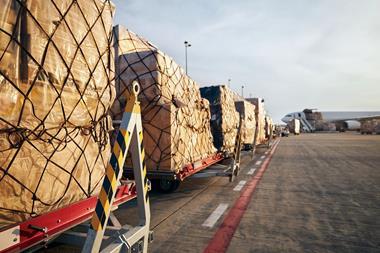





The trade war has shaken the global trade landscape and the air cargo industry is feeling the strain, not least in the freighter conversion market.
At the time of writing this column, relations between the two largest global economies had undergone a decline that had deteriorated at a dizzying pace to a point where trade seemed no longer viable for most of the commodities moving between them.
Washington had exempted cell phones, computers and semiconductors from its 145% tariffs on Chinese goods, but even this reprieve was supposed to be temporary.
The trade war has shaken the global trade landscape that had evolved since the end of World War II. In light of the destruction and over 50m casualties wrought by this global conflict, political leaders came to the conclusion that nations that trade with each other don’t shoot at each other.
For sure, the cold war threatened nuclear annihilation, and armed conflicts have been a constant presence in parts of the world, but for the most part the expanding global trade and the globalisation that it set in motion appeared to be creating a degree of integration that would be hard, and foolhardy, to unravel.
The rise of nationalism and the crescendo of calls for trade barriers put these assumptions in doubt.
For the air cargo industry as well as the overarching aviation industry, these are worrying developments. The prospect of a global recession implies a drop in trade as well as in travel.
The escalation also spells disaster for Boeing. Beijing’s order to Chinese airlines to stop buying US-made aircraft threatens a massive hit to the plane maker’s business.
According to IBA, as of 15 April, Boeing had a backlog of 236 aircraft ordered by Chinese carriers – 212 B737s, 20 B787s and four B777 freighters.
This translates into 3.7% of the manufacturer’s backlog and a hit of $15bn at current aircraft values, not to mention future sales in a market that Boeing has always been bullish on, although it lost ground to rival Airbus in China.
It also affects freighter conversions. Aeronautical Engineers Inc. was set to ship a 737 conversion kit to China for the re-configuration of a second plane in the HNA Group, but that had to be put on hold.
At the time of writing, neither side appeared willing to take the first step toward negotiations, let alone a resolution of their conflict. For the sake of the global economy, international trade and the air cargo industry, a resolution cannot come soon enough.