




Source: Jaromir Chalabala/Shutterstock
Widebody freighter capacity operating on the transpacific trade lane has continued to recover over the past week, but still lags behind the levels reported a year ago.
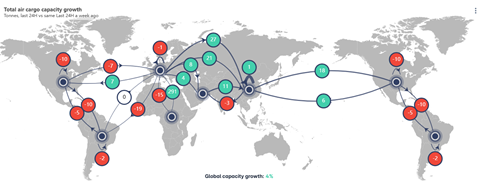
Figures from consultant and data provider Rotate show that over the past 24 hours, widebody freighter capacity operating between Asia Pacific and North America has increased 18% compared with the same period last week - the equivalent of 10 widebody freighter flights.
Last week, carriers had been rapidly pulling capacity out of the market as demand declined due to the US ending of the de minimis exemption for e-commerce parcels from China. This followed on from the implementation of 145% tariffs on all other imports in April.
At one point early last week, transpacific freighter capacity was down by 40 freighter flights per day compared with the April average, which represents a decline of 4,000 tonnes per day or 40% of previously operated capacity.
Capacity two weeks ago was also affected by the Labour Day holidays in China and there would also have been a bounce back in demand related to this.
Following talks between the US and China over the weekend, the tariff to be paid for de minimis shipments transported through postal networks - mostly e-commerce parcels - will be reduced to 54% (or a flat fee of $100) from the previous level of 120%. Other non postal e-commerce de minimis shipments will be subject to a 30% rate in line with the overall US tariff rate for goods from China.
While capacity on the Asia Pacific-North American trade lane has been recovering compared with last week, it still lags behind last year.
According to Rotate figures, widebody freighter capacity on the trade lane on Thursday, 15 May, was 10% lower than a year ago, the equivalent of 10 freighter flights.
When widebody passenger capacity is included, the difference narrows slightly to 7%.