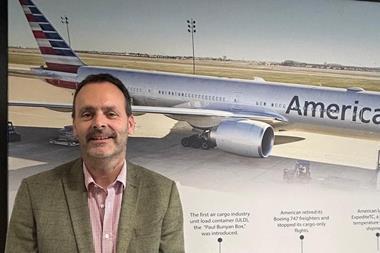


Roger Samways, American Airlines.
Source: American Airlines
American Airlines Cargo is adopting a nimble approach to the market as the outlook for the remainder of the year remains uncertain.
Speaking to Air Cargo News at the recent Air Cargo Europe show, American Airlines Cargo vice president of commercial Roger Samways said that volumes had held up relatively well so far this year despite the trade turmoil caused by the imposition and subsequent suspension of tariffs.
Samways said there were two reasons for the positive performance. Firstly, the on/off nature of the tariffs had resulted in several waves of front loading as companies looked to move goods quickly while duties were at a lower level.
Secondly, cargo flows have changed rather than disappeared completely. For instance, American has noticed a surge in demand from Latin America while volumes from Asia Pacific have been up and down depending on the tariffs.
He also added that American Airlines' exposure to China had been limited as only 26% of passenger flights to the country that existed pre-Covid have been reinstated.
Meanwhile, demand for essential perishables and pharmaceuticals had remained strong.
However, the outlook is more difficult, Samways said.
“At some point in time it is going to become more expensive to move goods into the US and I think manufacturers are trying to protect against that [with front loading] but you can’t see a continuation of these sorts of volumes unless there is an increase in consumer spending and the general macroeconomic conditions at the moment suggest that probably isn’t going to happen,” he said.
On the supply front, Samways said that cargo capacity has been dynamic, with freighter aircraft switching from the transpacific to Latin America and the transatlantic in line with the implementation of tariffs.
He added that much of that freighter capacity has returned to the transpacific, but it is something the airline is “watching very closely”.
A flexible approach
To combat the uncertain market conditions, Samways said that American would be flexible with its approach to the market.
"One thing we have learnt as an industry over the past few years is that we have to remain flexible and we have to be prepared to adapt to what the market throws at us," he said.
The cargo division has a couple of tools in its arsenal that allow it to be flexible in terms of its network: its road feeder operation and interline agreements.
"Germany is a huge market, but we have about three times as many flights out of Spain and we have a significant amount of business out of Paris, so we are utilising trucks to bring business from Germany to our hubs in Paris, Madrid and Barcelona and connecting to the US," said Samways.
He added: "Interline has long been an important part of our offering, but it has grown substantially in terms of importance in the last few years. Last year was a record - about 15% of our total revenue for the last six months of the year was interline related."
He said interline agreements allow it to offer origins and destinations that it doesn't serve directly, such as parts of the Middle East, Africa and the Indian Subcontinent, and also offer increased capacity in markets where it is capacity-constrained.
"We have an interline team that has been building stronger relationships with a core group of carriers that have the same approach to interline as we do."
"We have an interline team that has been building stronger relationships with a core group of carriers that have the same approach to interline as we do," he said.
Samways explained that around 85% of American Airlines Cargo's interline business is with 12 partners that can provide a high level of service and visibility.
"As we have established regular flows of business with a relatively small number of partners, that supports more consistent operational processes, so you are moving very consistent flows of cargo, transferring to the same interline partner in the same market," he added.

Investing to stay ahead
The cargo business has also continued to make investments to enhance its facilities.
For instance, it is expanding its Dallas Fort Worth facility, with work already underway to enhance both the warehouse and the office space.
In London, American moved into a new facility in November. The new building offers a total of 120,000 sq ft, a 15,000 sq ft increase compared to the original combined facilities, and also nearly doubles the capacity for storage of PMC pallets.
There are also more landside and airside doors, X-ray machines and build stations at the new building – all of which enable faster acceptance and delivery as well as build-up and break-down efforts.
In addition to the facility move, American has also updated how it transmits operational updates digitally with its ground handler in London, WFS. The combined effort enables a new digital connection between the WFS system, CargoSpot, and American’s iCargo platform.
This is going to be rolled out at a number of other stations in the coming months, Samways added.
American was also CEIV pharma accredited at its New York JFK and Luis Muñoz Marín International Airport facilities last year and as part of the process, expanded its New York CRT and 2-8 rooms, while it is also in the process of expanding its cooler capabilities in Miami.
In total, American operates more than 30 CEIV or GDP-certified locations around the world, including Miami International, Amsterdam Airport Schiphol (AMS), Dublin Airport (DUB), Frankfurt Airport (FRA), Paris Charles De Gaulle Airport (CDG), Rio de Janeiro Galeão International Airport (GIG) and Shanghai Pudong International Airport (PVG).