



Photo: Emirates SkyCargo
Emirates SkyCargo reported improvements in both cargo volumes and revenues in its last financial year as further freighter capacity was added.
The Dubai-headquartered cargo business recorded a 7% increase in cargo volumes to 2.3m tonnes while cargo revenues improved by 18% to AED16.1bn in the financial year running to 31 March 2025.
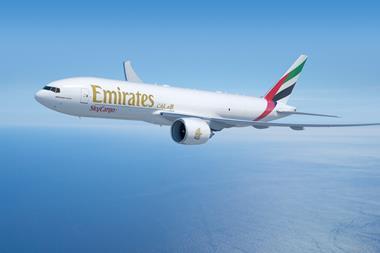
The company said performance was boosted by the delivery of two new Boeing 777 freighters and two wet-leased Boeing 747 freighters.
Cargo revenues contributed 13% of the Emirates’ total revenues. Meanwhile, Cargo yield per Freight Tonne Kilometre (FTKM) increased by 10%, "returning to pre-pandemic marketplace levels”.
Performance would also have been boosted by a strong year for air cargo, with demand rising and airfreight rates on the up.
”The global air cargo market experienced significant growth over the past year, with gains in both volumes and yields across the industry, partly due to the geopolitical situation affecting shipping routes in the Red Sea. Emirates SkyCargo successfully leveraged these favourable market conditions,” the airline group said in a results release.
Scheduled operations saw substantial tonnage growth of 10% to 1.8m tonnes, while freighter operations maintained a stable year-on-year performance at 570,000 tonnes.
"Demand for our specialised products and comprehensive network of freighter and belly-hold cargo operations was exceptional this year, with significant volume contributions from China, India, Pakistan, the UAE, and Bangladesh," the company said.
"The continued growth of e-commerce demand from the Far East, and specifically from Hong Kong, enabled strong revenue flows across traditionally low-season periods such as Christmas and Chinese New Year.
"Emirates SkyCargo effectively responded to increased market demand by enhancing its fleet and network capabilities."
During the year, Emirates added Copenhagen to its freighter network and signed a memorandum of understanding with Astral Aviation to expand its reach in Africa.
Emirates Delivers, an e-commerce delivery solution, was launched in Saudi Arabia to connect local shoppers with online retailers in the US and UK.
As part of its ongoing digitisation push, the cargo division launched eQuote, a digital ‘self-service’ touchpoint that enables customers in 75 countries to request and manage spot quotations anytime, anywhere.
Emirates also placed orders for 10 more Boeing 777Fs and has a total of 11 777Fs freighters on order. It expects to operate a fleet of 21 freighters by December 2026.
Emirates’ SkyCargo’s total freighter fleet currently stands at 11 Boeing 777Fs after taking delivery of two aircraft earlier this year. It also has a total of six wet-leased 747Fs.
The airline is also considering an order for next generation 777-8Fs or Airbus A350-1000Fs.
dnata volumes up
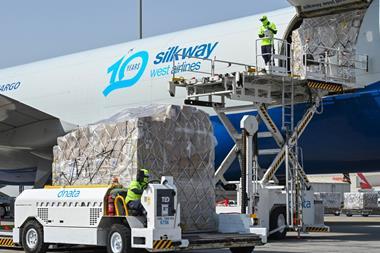
The Emirates Group's ground handling business, dnata, also saw cargo volumes increase. The company saw volumes grow by 9% to 3.1m tonnes, reflecting new contracts won, and increased flight activity by dnata’s airline customers.
The company would have benefited from rising cargo volumes overall and an increase in the use of sea-air solutions in response to the Red Sea missile crisis.
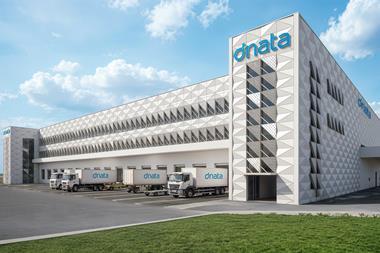
"This year, dnata made significant cargo infrastructure investments to meet customer demand. In Dubai, we invested $27m in a new 57,000 sq m warehouse in Dubai South, supporting Dubai’s continued growth as a global logistics hub," the company said. "In Zürich, we signed an exclusive lease agreement with the airport authority to operate its new, advanced warehouse when it opens in early 2027."
"Cargo handling services continued to thrive with a 17% surge [in revenues] to AED3.1bn. Making up 31% of the segment’s revenue, this stellar performance was driven by a 9% boost in cargo volumes, well-calibrated pricing changes, and exciting growth in ancillary cargo services including logistics and warehousing."
During the year, dnata also dnata broke the 1m tonne mark for cargo handled in Dubai.
The overall Emirates Group generated a pre-tax profit of AED2.75bn and posted a AED20.5bn profit after taxation, including the new UAE corporate tax of 9%.