


Photo: Etihad Cargo
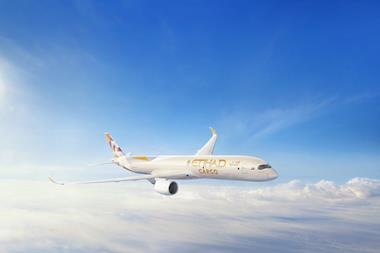
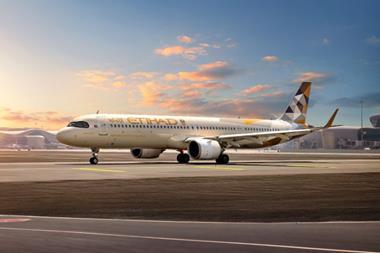
Etihad Cargo has plans to add additional freighters as it prepares for the arrival of its new A350 freighters, while business has been brisk in the first part of the year.
Speaking to Air Cargo News, Etihad Airways’ chief cargo officer, Stanislas Brun, explained that it was likely that the carrier would add additional widebody freighters in the coming years.
Brun said that the airline was hoping to gradually build up its freighter capacity ahead of the arrival of the 10 Airbus A350Fs the company had ordered.
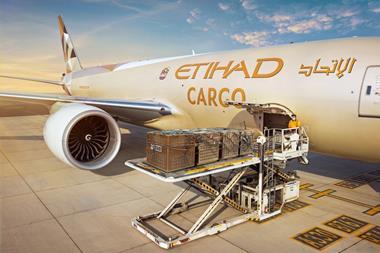
In total, Etihad plans to eventually operate a fleet of 13 freighters (10 A350Fs and three Boeing 777Fs) once deliveries are complete, seven more than the six freighters (five 777s and one Boeing 747) it currently offers.
Brun explained that by incrementally increasing its fleet ahead of the arrival of the A350Fs, the company would “not have a mountain to climb” when it came to trying to fill the extra capacity.
Any extra aircraft it takes on in the meantime would leave the fleet as the new freighters were delivered.
According to Airbus’ current timeline, the A350Fs should begin to be delivered in the second half of 2028.
As a move in this direction, Etihad Cargo most recently added a wet-leased Boeing 747 freighter that will support “increased freight movements on high-demand routes and provide customers with greater flexibility in shipping cargo to and from key markets”, the airline said.
In line with the arrival of the freighter, Etihad Cargo has added three additional weekly freighter flights to Shenzhen and two additional weekly flights to London. Brun added that the airline is also adding extra capacity from China to New York.
In total, the 747F expanded the airline’s freighter capacity by 18%.
Meanwhile, Brun said that Etihad Cargo’s volumes have increased over the first five months of the year despite the trade environment.
He said that the airline had largely escaped the worst of the impact of tariffs as its share of capacity on North American trades is around 3%.
“It’s dynamic, we need to stay sharp on what we are doing,” said Brun.
He explained that the Etihad Cargo network this year had remained largely unchanged after it added additional capacity to Asia last year.
However, bellyhold operations are growing rapidly, which has helped boost the cargo division’s performance.
In total, Etihad Airways will add 16 new passenger destinations on the back of the arrival of 20 aircraft this year, following on from the addition of 20 new destinations last year.
While Etihad has not directly been affected by the US tariffs, Brun said that there has been an indirect impact.
He said the trade environment meant that shippers were conducting an increased number of tenders in light of the uncertainty, and this, in turn, meant that forwarders are also putting airlines under pressure with pricing.
Brun said, however, that Etihad has strong partnerships with its customers and “cannot be ignored” in growing markets such as Vietnam, where it has recently added a fifth freighter frequency, which has helped protect it.
The airline also continues to grow in the pharma and perishables market. In fact, Etihad recently signed an agreement with the Department of Health in Abu Dhabi and pharma firm GSK for the storage and transport of products.
Also related to pharma and perishables is the launch of SmartTrack, a service that gives customers real-time access to shipment location and status data.
SmartTrack was developed in partnership with San Diego, California-headquartered tracking and logistics solutions provider Tag-N-Trac.
It uses sticky labels that can be put on the side of shipments to monitor location, temperature and humidity, shock, tilt and light exposure.
The labels upload shipment information using cellular, GPS, Bluetooth and Wi-Fi connectivity.
The smart label can remain active for up to 30 days with data uploaded onto the Etihad Cargo platform and app.
In terms of perishables, the airline has been transporting produce for use in hotels in locations such as the Maldives, Seychelles, Madagascar and Mauritius.
Brun adds that the UAE is also expanding its perishables output through investment in agritech.
Etihad Cargo has also continued to enhance its partnership with China-based SF Airlines.
At the recent Air Cargo Europe event, the two signed a Joint Business Agreement (JBA) that is designed to enhance their cargo operations and expand their network capacity.
The partnership, Etihad said, is designed “to foster incremental growth and create a seamless, shared network that offers customers an expanded range of destinations, increased cargo capacity and enhanced service efficiency”.