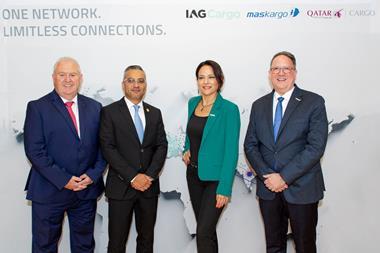



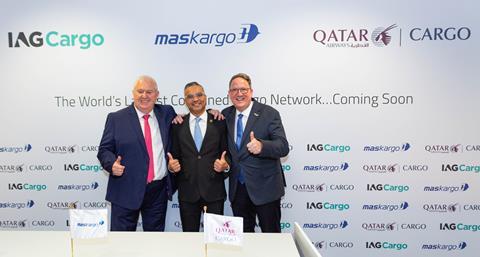
Qatar Airways Cargo, IAG Cargo and MASkargo are striving to create an air cargo partnership that bypasses the downfalls others have faced by adopting a fully integrated operating model.
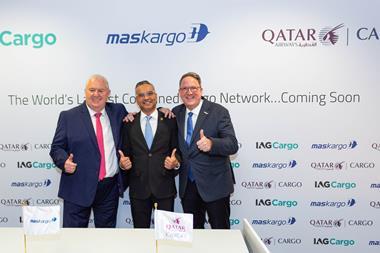
The three airlines announced they would launch a joint global cargo business in April. This month, the heads of the businesses came together to explain how their partnership planned to avoid the pitfalls that previous partnerships have faced.
Speaking at a press conference at Air Cargo Europe in Munich, the partners admitted that cargo partnerships have faced insurmountable challenges in the past, but the new partnership, which they describe as unique, will align cargo from booking to delivery, across the networks of all three carriers.
IAG Cargo chief executive David Shepherd conceded: “Cargo partnerships haven’t taken off as well as passenger partnerships have.”
He said one of the reasons why cargo partnerships haven’t worked as well is “because actually connecting cargo can be quite difficult – it can be met with quite a bit of friction, particularly on the ground and the ground operations. But also even from the point of booking, quite frankly”.
The Qatar-IAG-MAS partnership aims to ensure bookings with any of the airlines will be integrated and visible across all operating systems, covering the whole combined network.
Real-time tracking, product/service alignment for various verticals and a singular loyalty programme - Avios - will also be used, said Shepherd.
As well as full transparency and optimum efficiency, the aim here is also to ensure that shipments are treated equally throughout the combined network, regardless of which airline a customer or forwarder originally booked with.
Shepherd explained: “We’re working to create a completely seamless operational connectivity here as well – from booking all the way through to the transportation of the goods. I think that’s what we’re creating here, that’s unique in the world of air cargo.”
Hub alignment
The carriers will also streamline their hub operations because, while passengers can make their own way from one terminal to another, freight cannot, pointed out Shepherd.
Therefore, establishing and maintaining efficient shipment handling “can be difficult when you’re not co-located in the same place”.
Getting this right is crucial for the three carriers, which each offer sizeable capacity and different regional strengths, but now have a powerful aid to further grow their global connectivity.
London Heathrow-headquartered IAG Cargo, which utilises the belly capacity of five airlines in the IAG Group, is prominent in Europe. Meanwhile, Doha-based Qatar has key network advantages in the Middle East, as well as a large passenger and freighter fleet.
Likewise, Kuala Lumpur-based MASkargo has extensive reach within Asia, served by a passenger fleet and a fledgling, but growing freighter fleet.
More than 900 aircraft are managed by the three airlines in total. There are over 400 destinations served and six global hubs.
Shepherd assured: “Already we’re co-located at many of the hubs that we operate at in Doha, in KL, and we’re going to be working over the course of the next year to make sure that we’re co-located in the places that we need to be.”
The airlines are keen to point out that the partnership is more sophisticated in its design than other partnership models.
“We’re very conscious of where partnerships have fallen down in the past and that interline is nowhere where it needs to be,” said Shepherd. “This is not an interline partnership; this is a fully integrated seamless operational partnership”
He highlighted that the partners are not simply carrying on with business as usual under the name of a partnership, or utilising each other’s services where it does not make sense to do so because of the new partnership.
Rather, the integration of the commercial operations of the businesses is key to success.
“We believe that the commercials that sit behind this mean that whenever we build something, we’re building it for the partnership, not just our own businesses”.
The global nature of the partnership makes it stronger than others that have been established in the past and better able to overcome hurdles, the partners believe.
“I think commercially, the global nature of this partnership, it’s crucial to understand that we’ve got a lot of competition out there that tend to collaborate on a route-lane basis," Shepherd stated.
“We’ve got competitors that collaborate between Europe and Japan, Europe and Hong Kong, Europe and the US, but actually this is a full global programme with full global connectivity.”
Qatar Airways chief cargo officer Mark Drusch explained that to ensure the continued success of the partnership, the airlines plan to share data “to understand which markets are growing, which products are growing, which regions are growing and then determine how we jointly deploy assets and resources to address those market needs”.

Cargo partnerships past
Any number of issues, from structure to planning to market conditions, can affect the success and ultimate longevity of an air cargo partnership, history shows.
Qatar decided to divest a 35% stake in Cargolux in November 2012, less than 18 months after announcing the deal. At the time, the decision was seen to put a spanner in the works of Qatar's plans to expand in Europe.
In January 2024, Air France KLM Group and CMA CGM decided to end their cargo capacity partnership due to the constraints of a "tight regulatory environment" that prevented them from working together in the way they had planned, although they still had plans to further work together again.
Still, this new partnership is designed to be like no other, meaning any challenges may also be like no others encountered before.
Striving for aligned networks, operating models and working practices aside, some might question how the financial elements of the Qatar, IAG and MAS partnership may work.
This isn’t something the partners are open to discussing, but Drusch said the focus is “how do we generate more revenue for each other”.
He said they have designed the partnership to ensure that “we are getting a bigger share of an important market” and that “each one of us is together bringing more than if we approach it individually”.
Drusch stressed all the airlines are in an equal partnership and it is a joint business (JB), not a joint venture (JV) and therefore “there is no financial investment in anybody else”.
That said, depending on the success of the current venture, the partners say they are open to further collaborations in the future.