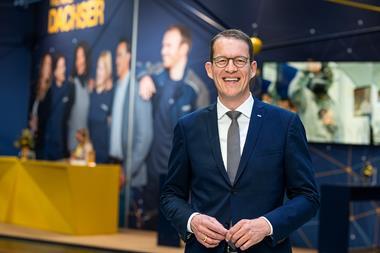




Burkhard Eling, Dachser
German logistics company Dachser’s solutions-based approach is helping it avoid the worst of the current market uncertainty, according to chief executive Burkhard Eling.
Speaking to Air Cargo News, Eling says the year so far has been better than expected and that Dachser has avoided the worst of the tariff-related uncertainty because it is “not so heavily dependent” on the transpacific trade lane and provides services to a range of verticals.
“From that point of view the direct impact is so far a positive one because like a lot of others, we have benefited from the catch up effect as everyone wanted to be prepared for 2 April (when US tariffs were first due to start) and then the beginning of July,” he explains.
“There has been a lot of business coming in that is actually re-routed from the transpacific where for weeks you had almost a total shutdown [due to tariff rate of 145% in late April and early May].”
Eling adds that the most difficult aspect of the market this year has been the uncertainty caused by the regular changes to tariffs.
As a result of the uncertainty and weak growth outlook, he says that there are a “lot of tenders coming in” and “tougher price negotiations”.
The company’s solutions-based approach has helped protect it from some of the impact.
“What we do well is to really analyse the whole supply chain of the customer. We get all the data and use our network to optimise the flow of goods for our customers.
“So instead of thinking tender here, being the cheap there, having this trade lane, we are really looking at the full supply chain, and this is really when Dachser’s capabilities come into play.”
Looking ahead, Eling says there is “enormous uncertainty” but he hopes Dachser will benefit from some ad hoc bonded warehousing opportunities in Mexico and Canada as companies look to move goods ahead of any new tariffs.
In terms of airfreight capacity acquisition, Eling says that Dachser is taking a more short-term approach than it has over the last few years, given the uncertainty, but it still has block space agreements and has maintained some of its air charter network, although this has been greatly reduced since its Covid highs.
Investing in the future
However, Eling says that while the current market conditions encourage a shorter term view, this doesn’t mean the company has stopped looking long-term.
He explains that Dachser has been investing in emissions reduction and its IT systems in recent years and will continue to do so.
On the technology front, Dachser recently announced a partnership with The Fraunhofer Institute for Intelligent Analysis and Information Systems to look into machine learning and artificial intelligence (AI).
One key area of logistics where AI could usefully be applied is in the processing of unstructured data or data in different formats.
The company is already using AI applications to provide employees with support in decision-making and to relieve them of monotonous tasks.
Another key area of investment for the company in recent years has been acquisitions.
Eling says Dachser has made eight acquisitions in recent years, which have added more than $1bn in new turnover and 4,000 employees.
The company attributed a 13% increase in revenues to €8bn last year largely to the acquisitions of Dachser & Fercam Italia, Frigoscandia, and Brummer as the European economy was flat.
Asked if there were plans to make further acquisitions, Eling responds: “At the end, we look by business line, so where do we need to grow our footprint with regards to food logistics, where do we need to extend our European logistics set up and of course, air and sea.
“So, nothing new and also nothing concrete to talk about at this time, but definitely more to hear of.”
Asked where the company could be looking to expand its footprint, he mentions Southeast Asia, India and North America as areas for potential expansion.