





Photo: Qatar Airways Cargo
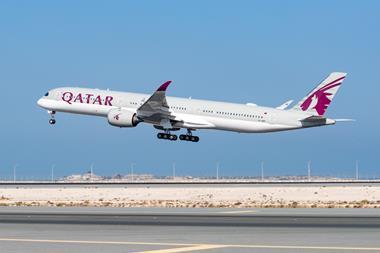
Qatar Airways has restarted flights from Doha after the country’s airspace was closed yesterday due to Iran launching missiles against US bases in Qatar and Iraq.
In a notice issued at 1.20am, the airline confirmed the reopening of the country’s airspace but warned of ”significant delays” to its flight schedule as operations got back underway.
“We are working tirelessly with government stakeholders and the relevant authorities to restore operations as quickly as possible,” the airline said in a statement.
Air Cargo News has requested a comment from Qatar Cargo on the disruption caused to its operations.
According to data provider Rotate, the closure had a "major" impact on operations at Doha Hamad International airport, with flights suspended for around six hours.
According to the firm's vice president and head of consulting, Tim van Leeuwen, Rotate's data shows around 200 flights were impacted.
He said many flights were diverted to nearby airports or back to flights' origins.
"Even after an inbound wave of flights after airspace reopening, the airport is still short of around 100 flights," he said.
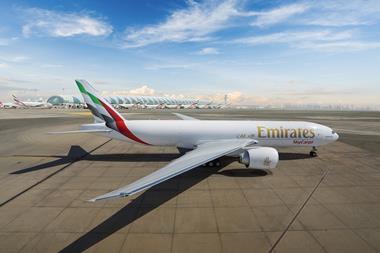
Emirates SkyCargo said that as a result of the ongoing geopolitical instability in the region, additional fuel is being uplifted on flights departing from Dubai, which may result in payload constraints and shipment offloads.
Qatari airspace reopened after a ceasefire was reportedly reached by Iran and Israel, although the ceasefire now appears to have broken down.
Iran’s attacks on US bases followed on from the US launching missiles against Iran last week.
The US attacks also caused disruption to airline operations over the weekend and on Monday as several airlines cancelled flights to locations such as Dubai, Doha and Riyadh.
Airlines that reportedly cancelled flights include British Airways, Air France KLM, Singapore Airlines, Air Canada, Finnair, Air Astana, United Airlines and American Airlines.
This is in addition to the ongoing cancellation of operations to Israel, Iraq, Iran, Jordan, Lebanon and Syria since earlier in June as a result of the wider conflict and airspace restrictions.
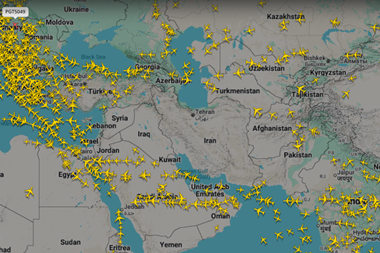
Flights are also continuing to divert around the main conflict zone in the region, with images from FlightRadar showing the extent of the re-routes.
The area has been largely empty of flights since Israel began strikes on Iran.

Source: Courtesy of Flightradar24.com
Freight forwarder Scan Global Logistics (SGL) said the diversions are already adding to the cost of operations.
"Several airlines have begun rerouting flights to avoid sensitive Middle Eastern airspace, increasing transit times and operational costs," the company said in a market update.
"The effect is already being felt on long-haul lanes connecting Asia and Europe via the Middle East."
It added that the cancellation of flights to and from Dubai had caused a short-term surge in demand and rates.
SGL also warned that sea-air operations out of the Middle East could also be affected.
"A prolonged conflict will also have an immense effect on the Sea-Air market with Dubai being a key hub for Asia to Europe volumes, with this in turn likely to build pressure on other well-known Sea-Air hubs such as Colombo and Singapore. Consequently, increasing rate levels on Sea-Air shipments should be expected in the coming period," SGL said.
"Generally, the effects related to the Israel, US and Iran conflict are, for now, considered to be limited to the Middle East region, and accordingly, we expect a stable development on Asia to Europe still, and naturally Far East to US is also not impacted."
According to FlightAware, there are 27 flights cancelled out of Dubai today and 10 inbound flights. Meanwhile, seven outbound flights from Doha are cancelled and eight inbound flights are cancelled.
Despite the disruption, cargo capacity to and from the Middle East region appears to be holding firm compared with the start of June.
Rotate figures show that cargo capacity from the Middle East to Europe stood at 13,000 tonnes between Saturday and Monday, around 1,000 tonnes less than between 7-9 June.
In contrast, cargo capacity from Asia Pacific to the Middle East was up between the two periods by 2,000 tonnes to 18k tonnes.