



China-US e-commerce air cargo volumes have rebounded to near 100,000 tonnes after dropping 43% following the end of the de minimis exemption

Air cargo’s e-commerce volumes have remained strong this year despite the US decision to end the de minimis exemption, with volumes from China to the US returning quickly.
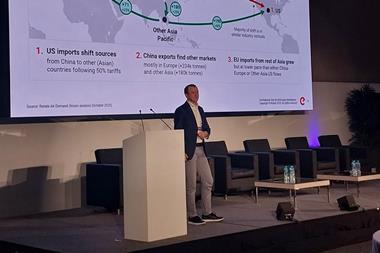
Speaking at TIACA's Air Cargo Forum in Abu Dhabi, Marco Bloemen, managing director of consultant Aevean, said that following the US decision to end the de minimis exemption for China in May, which allowed packages to enter the country duty-free and with minimal customs scrutiny, there was a drop off in e-commerce air volumes between the two countries.
Bloemen pointed to figures showing a 43% month-on-month decline in e-commerce volumes transported by air between China and the US between May and June, from just over 100,000 tonnes per month to around 60,000 tonnes.
However, volumes between the two countries have been recovering since then and in September were again approaching 100,000 tonnes.
Meanwhile, the Chinese e-commerce platforms have also been shifting their focus to other countries and the overall US share of the market has declined as a result.
Between July and September 2024, the US accounted for 25% of the Chinese e-commerce market. A year later, this had declined to 18%.
Belgium, Hungary and the UK were some of the fastest-growing destinations, with Europe’s share increasing from 22% last year to 25% this year, Bloemen said.
”We saw the drop [in e-commerce volumes] in May from China into the US, but now the US is getting the e-commerce volumes from China again,” said Bloemen. “And we have also seen growth into Europe, into Southeast Asia, into Latin America and other countries.”
Others at the event were also confident in e-commerce and its future in air cargo.
Speaking on a panel discussion, Edward Burek, vice president of marketing and partnerships at SmartKargo, said he felt the US e-commerce market would "right-size pretty quickly" following the end of the de minimis exemption.
"The market has always been adaptable, especially around e-commerce, whether that’s through partnerships or outsourcing back to the US for manufacturing.
"The American economy is still growing and e-commerce is still growing at 8% across the board. People aren’t opening more stores; they are working more on their phones, which means you are looking at e-commerce as the primary vehicle."
Dennis Lister, senior vice president, product and innovation, Emirates SkyCargo, added that the airline had not seen a drop off in e-commerce demand.
"We see this continued powerhouse from the Far East pushing volume into the network. We feed out from Dubai to the rest of the world and we haven’t seen a dramatic impact in terms of our capacity; we are filling our capacity.
"The volumes will find a way to get to where they need to get to. If one tap is turned off, another one opens somewhere else."
Budapest Airport cargo director József Kossuth was also confident in the long-term growth of e-commerce.
"E-commerce will stay with us long term," he said. "There are always challenges. Maybe there will be too much for the US this year with Trump and the de miimis ending, but long term, there is no question that this is a change in consumption behaviour which will stay with us in the long term.
"There are many things that can happen in terms of geopolitics, also in our region, but still the demand is there and it is growing."