

Digitalisation, data, and collaboration are shaping the next chapter of air cargo’s e-commerce evolution

E-commerce has reshaped the world’s air cargo networks at breathtaking speed, and digitalisation, data, and collaboration are key to maximising the benefits.
What began as a small stream of lightweight ‘parcels’ has evolved into one of the industry’s strongest and most resilient growth engines, with volumes acting as a stabilising base amid cyclical downturns.
Even amid global trade uncertainty, capacity fluctuations, and cost pressures, e-commerce operations have continued to grow and evolve, especially in the last 10 years.
While e-commerce growth stabilised following the pandemic-driven surge, e-commerce sales surpassed $6.3trn in 2024 and are forecast to reach $8trn by 2027, according to eMarketer.
Online retail has continued to expand across emerging markets, with Southeast Asia, India, and the Middle East showing some of the world’s fastest growth rates.
While maritime and road transport handle the bulk of total e-commerce tonnage, air remains indispensable for cross-border, time-sensitive, and high-value shipments, particularly in the fast-moving sectors of electronics, fashion and healthcare.
Cross-border e-commerce has become a defining force in international logistics. According to IATA, cross-border shipments now represent up to 25% of global air cargo volumes, driven largely by consumer expectations for rapid fulfilment and visibility.
For airports, airlines, cargo ground handlers, and integrators, this segment offers both promise and pressure. Consistent demand is paired with operational complexity that requires agility, digitalisation, and collaboration.
Harnessing technology is key to ensuring the air cargo industry will adapt to sustain and profit from e-commerce over the long term, while embracing flexibility is crucial to effectively deal with challenges.
One such challenge has been the legislative crackdowns on e-commerce this year.
The end of the de minimis exemption in the US saw volumes shift from China-US to China-Europe, demonstrating that the whole industry needs to be alert to how quickly demand and supply chains can shift, although volumes to the US have recovered and not to the detriment of volumes to Europe.
Meanwhile, European Union (EU) member states have agreed to introduce a €3 customs duty per item on e-commerce parcels valued below €150 from July 2026, to bridge the gap until the setting up of the EU Customs Data Hub in 2028. The UK also plans to end the de minimis exemption by March 2029 at the latest.
Rethinking networks and fleets
Airlines have also been forced to rethink the very structure of their cargo networks to support e-commerce developments.
The traditional long-haul, palletised model is evolving toward higher-frequency, regionalised operations, which emphasise speed, predictability, and often smaller shipment sizes.

Image source: Emirates SkyCargo
Airlines are now actively adjusting fleet strategies to align with this demand. Narrowbody and converted freighters, such as 737-800 Boeing Converted Freighters (BCFs) and Airbus A321 passenger to freighter (P2F) conversions, are increasingly deployed to feed major hubs and connect secondary e-commerce gateways.
These aircraft offer the flexibility and cost-efficiency needed for dense, high-frequency routes.
Some airlines are taking it further by developing dedicated e-commerce divisions or product verticals. China Airlines, Lufthansa Cargo, and Emirates SkyCargo, among others, have introduced specialised e-commerce solutions that blend air transport with digital order management and last-mile partnerships.
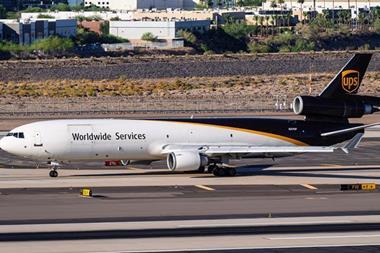
Meanwhile, integrators like FedEx, UPS, and DHL Express continue to expand regional air networks in Asia-Pacific to shorten delivery cycles and support marketplace-driven fulfilment models.
The smaller, high-turnover shipments typical of this trade generate a strong yield per kilogram compared to traditional freight, despite their operational complexity.
From a revenue perspective, e-commerce is reshaping yield management. The smaller, high-turnover shipments typical of this trade generate a strong yield per kilogram compared to traditional freight, despite their operational complexity.
The challenge lies in achieving density and optimising capacity utilisation, especially when balancing postal, express, and general cargo flows on the same aircraft. Air cargo revenue management requires expertise.
Grounding efficiency
If airlines are the lift, ground handlers are the pulse of the e-commerce air cargo chain on the ground.
The volume and velocity of e-commerce shipments demand ground operations that incorporate automation, smart data flows, and precision timing.
This is confirmed by Nikolai Schaffener, global head of commercial, Swissport International. He says: “Ultimately, the cargo ground handler’s core business is to serve its airline customers. A mindset change is, however, required.
“Swissport encourages the entire community to look beyond the airline customer and provide a larger contribution to the overall air cargo ecosystem. This leads to increased collaboration where there is mutual willingness to do so. It requires entrepreneurial thinking in how the system works.”
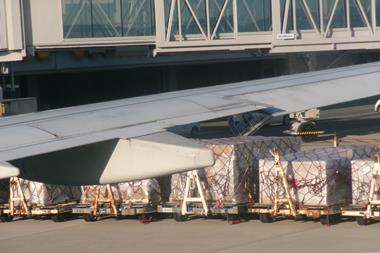
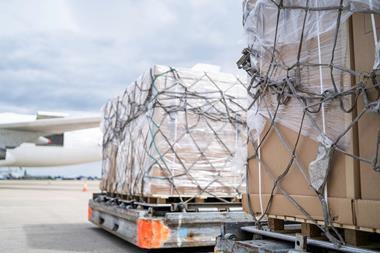
The average e-commerce consignment is smaller, less uniform, and less predictable than traditional air cargo. A single flight can carry thousands of individual parcels, each with its own label and data record. For cargo handlers, this translates to higher handling intensity on a piece level and shorter processing windows.
To meet these challenges, major ground handling companies are investing heavily in digital infrastructure and automation.
Schaffner confirms: “Our focus is on a digital toolkit that enables transparency and consistency across our global network. We ensure that our Cargo Management System, Cargospot, is installed at each location globally. This enables standardised messaging and communication with our supply chain stakeholders.”
Many airports, from Hong Kong and Singapore to Liege and Leipzig, are developing e-commerce-dedicated terminals, often in partnership with integrators, airlines or large e-commerce platforms.
This includes Swissport with Schaffner confirming that “there is huge potential in first- and second-line warehousing”.

He adds: “This has taken place, for example, in our network in Liege and Amsterdam with ‘tailor-made’ handling solutions which are combined under one operational roof.
”Workforce dynamics are also shifting. Automation works hand in hand with manpower to provide the best and most efficient service to our customers.”
Handlers are trying to upskill their workforce to manage data-driven processes, exception handling, and digital traceability through a variety of change management programmes that include third-party workforce models.
These models often provide a great flexibility in the ‘plug and play’ approach, but ultimately, as Schaffner states, “the responsibility of delivery towards the customer is not outsourced”.
The future cargo terminal is as much about systems integration as it is about people, forklifts and mobile workstations.
Data handling capability
If e-commerce is the demand engine, data is the fuel. The modern e-commerce shipment travels first through networks of information before it even reaches the aircraft. Transparency, predictability, and digital compliance are non-negotiable.
The industry’s collective digitalisation push is accelerating. IATA’s ONE Record initiative, due to be implemented by 1 January 2026, is a key component to this evolution as it is designed to replace the legacy patchwork of messaging standards with a single, standardised data-sharing model.
With ONE Record, all stakeholders from airlines and handlers to customs and forwarders can access and update the same set of shipment data in real time.
The actual uptake in the industry, however, remains to be seen. It’s not just about the big players; it’s about the larger number of small- and medium-sized organisations at both ends of the supply chain.
This harmonisation is essential for e-commerce, where speed and visibility are critical differentiators. The goal is to move from a document-driven process to a data-centric supply chain, enabling faster clearance, pre-alerted handling, and predictive exception management.
Complementary efforts such as Cargo iQ performance standards, electronic Air Waybill (e-AWB) adoption, and the expansion of API-based integrations between logistics tech providers are pushing the industry toward true end-to-end transparency, but there is a long way to go.
Airlines and cargo ground handlers are increasingly deploying machine learning models to forecast eCommerce peaks, predict offload risks, enable network steering, and dynamically allocate resources.
Artificial Intelligence (AI) and predictive analytics are also taking hold. Airlines and cargo ground handlers are increasingly deploying machine learning models to forecast eCommerce peaks, predict offload risks, enable network steering, and dynamically allocate resources.
Customs authorities in several regions, particularly within the EU and Southeast Asia are exploring pre-clearance models using shared data pipelines — allowing shipments to clear before they even land.
The next phase will be interoperability — creating a unified digital language across different cargo management systems, marketplaces, and logistics platforms. This is where the real efficiency gains will emerge.
Key challenges and constraints
Despite its momentum, the e-commerce air cargo ecosystem faces structural challenges that must be addressed for long-term sustainability.
1. Infrastructure pressure:
Major airport gateways such as Hong Kong, Incheon, Liege, and Amsterdam are seeing record volumes of small parcels, often stretching terminal capacity and sorting capabilities. Without investment in automation and smarter flow management, bottlenecks risk negating air transport’s speed advantage.
2. Data fragmentation:
While digitalisation is advancing, the global picture remains uneven. Many smaller forwarders and handlers still operate on manual or legacy systems. Without the broad adoption of common standards, the full benefits of ONE Record and similar initiatives cannot be realised.
3. Labour and skill shortages:
Handling e-commerce cargo efficiently requires both technology and skilled operators. Shortages in ramp and warehouse labour, combined with the need for digitally proficient staff, continue to challenge throughput consistency — particularly in high-volume hubs.
4. Sustainability and public perception:
The e-commerce consumer’s desire for next-day delivery often clashes with growing scrutiny over the carbon footprint of aviation and logistics. Airlines are accelerating the shift toward Sustainable Aviation Fuel (SAF) and fleet renewal, while logistics providers are investing in electric ground vehicles and optimised routing. But achieving measurable progress requires coordinated industry effort and transparent reporting.
Will e-commerce ever plateau?
In the near to medium term, the answer appears to be no. The rate of e-commerce growth may normalise, but it will remain a key driver of air cargo demand.
Delivery expectations are shifting from pure speed to predictability, visibility, and sustainability. Marketplaces and platforms will continue to consolidate their logistics ecosystems, with air cargo serving as the premium layer for time-definite deliveries and high-value goods.
What’s more, new product categories are entering the air e-commerce pipeline. Pharmaceuticals, temperature-sensitive goods, and direct-to-patient healthcare logistics are increasingly adopting the e-commerce model, further integrating traditional special handling cargo with retail distribution dynamics.
As automation and data maturity improve, we may see capacity planning evolve from reactive to predictive. Airlines could dynamically allocate belly space or freighter capacity based on e-commerce demand forecasts linked directly to online sales data.
The future e-commerce air cargo ecosystem will be less about chasing spikes and more about managing predictable, data-driven flows.
Collaborative future
E-commerce has, perhaps unintentionally, become the catalyst for long-needed transformation in the air cargo industry. It has forced stakeholders to confront fragmentation, data silos, and inefficiency head-on, therefore driving a collective shift toward integration.
Standardisation is there; it’s been around for a long time through IATA industry standards. But the old-time pain point of adoption is what’s needed to really embed this.
The most successful players will be those who view e-commerce not as a commodity flow but as a collaborative digital ecosystem. Airlines will need to forge freighter partnerships with cargo handlers, postal operators and platforms.
Handlers will need to invest in transparent systems that connect directly to airline and forwarder platforms. Regulators and customs authorities, too, will need to align on data-driven compliance models to enable true global harmonisation.
In this interconnected future, information becomes as valuable as cargo space. Data visibility, operational agility, and sustainable performance will define competitiveness far more than rate per kilo or transit time.
E-commerce has made the sector faster, smarter, and more customer-centric, but also more complex and data-dependent, which is the acceleration that’s been needed for several years to ensure the supply chain truly adopts the digital era.
As the global supply chain continues to digitalise, the distinction between e-commerce logistics and traditional airfreight will continue to widen.
The goal now is to ensure that the entire air cargo ecosystem, from the shipper to the consignee, moves in digital harmony.
The continued rise of e-commerce is not simply a trend; it is the foundation of a new air cargo era. Those who invest early in digital connectivity, harmonisation, and sustainable innovation will not only meet the challenge but define the standard for what comes next.