




Tariffs target select computing chips at lower rate than initially proposed, with exemptions for US data centre and industrial applications

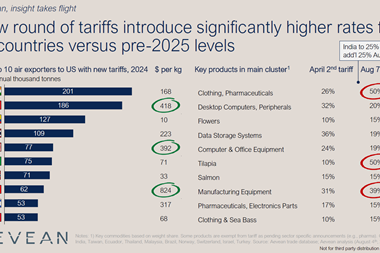
The US has implemented its threatened tariffs on semiconductors, although at a lower rate than initially expected.
Last week, the White House announced it would implement a 25% tariff on certain advanced computing chips, such as the NVIDIA H200 and AMD MI325X.
However, the tariff is at a lower rate than 100% initally suggested and only applies to a "very narrow category" of semiconductors.
Tariff will also not apply when the chips are imported to support the buildout of the US technology supply chain. This includes chips used for derivative devices imported for US data centres, startups, non-datacentre consumer applications, non-datacentre civil industrial applications and US public sector applications.
The tariffs follow a US investigation that found that the import of semiconductors, semiconductor manufacturing equipment, and their derivative products threatened to impair US national security.
The tariffs will "address the threat to national security by, among other things, incentivising domestic production of semiconductors and reducing our nation’s reliance on foreign sources and foreign supply chains".
"The US consumes roughly one quarter of the world’s semiconductors," the White House said in a briefing document. "The US currently fully manufactures only approximately 10% of the chips it requires, making it heavily reliant on foreign supply chains.
"This dependence on foreign supply chains is a significant economic and national security risk."
However, the White House said the president may in the future impose broader tariffs on imports of semiconductors and their derivative products, as well as an accompanying tariff offset programme to incentivise domestic manufacturing, as previously announced.
The semiconductor market has been one of air cargo's success stories in recent years as demand for the chips has soared.
The airfreight market in Taiwan has been one of the key beneficiaries, with estimates suggesting as much as 80% of semiconductors are made on the island.
At last year's TIACA Air Cargo Forum event, Asok Kumar, chief executive of Taiwan-headquartered Morrison Express, said that volumes out of Taiwan were surging because of demand for chips.
He was confident about the future of Taiwan's semiconductor market despite US efforts to increase domestic production.
”If the world’s demand for chips and servers grows by 100% and 50% of that is in the US, you’ve still got 50% of that coming out of Taiwan,” he said.
”If you look at it from a statistical standpoint, I don’t see the demand waning and I don’t see that in the conversations we are having with our customers and I don’t see that in terms of the plans being made for in terms of capacity planning and forward-looking.”
Greenland tariffs
Meanwhile, the US has also threatened tariffs on eight countries in relation to its proposed takeover of Greenland.
President Donald Trump has announced a 10% tariff on goods from Denmark, Norway, Sweden, France, Germany, the UK, the Netherlands and Finland that will come into force on 1 February.
He said the tariff rate could later rise to 25% and will last until a deal was reached.
Trump has claimed that the Danish territory is essential for US national security. In response, the seven countries have dispatched a small number of troops to the island in support of Denmark.