




The air cargo market is facing more uncertainty as the US has today implemented higher tariffs on dozens of countries.
Air cargo volumes of clothing from India and desktop computers from Taiwan will be among the sectors hit by the latest US tariff announcements.
However, how much of an impact the new tariffs will have on the various markets affected is hard to assess because of the different rates being applied to each location and because of the different types of products being exported.
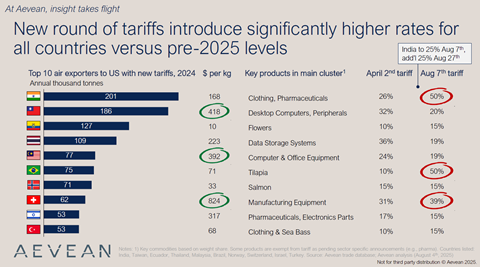
Consultant Aevean said that the 25% tariff on “large exporter” India was of note because overall airfreight volumes from India to the US stand at around 201,000 tonnes per year - the highest of any country on the list.
However, the lower value of the type of product being exported from India - especially given that one of its top exports, pharmaceuticals, is excluded from the tariffs - means the actual dollar rate paid per item will be comparatively lower.
Looking ahead, the US has also threatened to add a further 25% tariff on Indian exports from 27 August in response to New Delhi’s purchase of Russian oil.
Meanwhile, the tariffs on Taiwan, Malaysia and Switzerland are likely to have a “major impact” on the market given the high value density of goods exported from these locations, said the consultant.
Taiwan, which faces a tariff rate of 20%, exports around 186,000 tonnes of airfreight per year to the US, with major product categories including desktop computers and peripherals.
Malaysia exports around 77,000 tonnes of airfreight to the US each year, with major categories that will be hit including computer and office equipment.
Switzerland’s air volumes to the US stand at 62,000 tonnes, with pharma (exempted) and watches being important categories.
Aevean said that Ecuador’s flower market could be hit harder than that of Colombia as it faces a 15% tariff while the latter will have a rate of 10%.
Meanwhile, Aevean said that Brazil’s 50% tariff is high enough to drive sourcing shifts if not soon reduced, despite the low values of goods exported from the country.
The consultant said that while new tariff rates, revealed on 1 August, vary above and below the rates announced on 2 April (later delayed), they are all “still significantly higher” compared with historic levels.