Sustained demand for high-tech, e-commerce and fashion cargo drives Asia-Europe growth, though geopolitical factors require network adaptation
The latest IATA cargo figures show that global air cargo demand grew 5.5% year on year in November, marking the ninth consecutive month of overall growth.
Air cargo volumes between Asia and Europe (and vice versa) were up by 11.7% year on year, representing no less than 33 consecutive months of growth on this trade lane.
Indeed, the Asia-Europe trade lane saw the strongest performance of all intercontinental trade lanes, as measured by IATA’s cargo volume figures.
Asia-Europe trade is now worth 20.4% of the global airfreight industry, IATA reveals.
So much for the top-level figures. How are some of those players closely involved with the Asia-Europe airfreight trade faring?
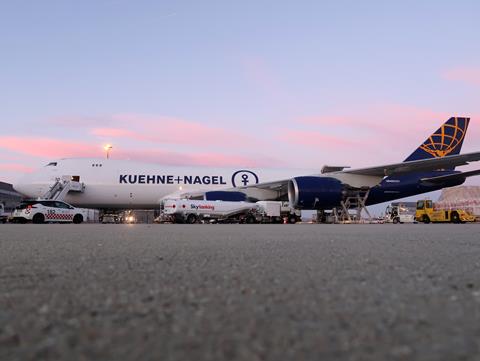
Tobias Hofemeier, senior vice president air logistics, Greater China at Kuehne+Nagel (K+N), explains that the global supply chain services giant has seen consistent demand for its airfreight-related logistics services on the Asia-Europe trade over the last six months.
There has been a notable increase in Europe-bound cargo from Asian countries, such as Vietnam, Taiwan, China, Hong Kong and Thailand, he informs, noting that this trend has been evident across a variety of sectors.
K+N has seen particularly strong demand for high-tech, electronics, cloud infrastructure and fashion-related cargo on the trade.
These commodities often require expedited delivery and reliable transit times, making airfreight the preferred mode of transport for many of the forwarder’s customers on the Asia-Europe trade, Hofemeier suggests.
E-commerce volumes have also grown, especially from China and Southeast Asia, driving demand to Europe, as e-commerce players look to new markets to offset the impact of the change in the US de Minimis rule in August last year (the Trump administration eliminated the $800 de minimis threshold for commercial shipments across all countries, making the rule apply regardless of country of origin).
Express service
Alongside the scheduled and charter airlines that move cargo either in freighter maindecks or in passenger aircraft bellyholds, the big integrators fly huge quantities of cargo on routes around the world, much of it express and e-commerce shipments, not least on the Asia-Europe trade.
Wouter Roels, regional president at FedEx Europe, tells Air Cargo News that, “we are optimistic about the opportunities for European businesses on this important trading corridor”.
“To facilitate this, we recently added five weekly flight connections between the two regions,” he adds.
“However, we know there are barriers for SMEs [small and medium-sized enterprises] on this trade lane. A recent FedEx survey of businesses across Europe shows that areas like complex customs regulations create challenges, and that SMEs cite digital tools as critical to simplifying cross-border commerce.
“That’s why at FedEx we emphasise not just our expansive physical network, but our digital capabilities and Customs expertise built over more than 50 years.”

The survey to which Roels alludes was conducted in September 2025. It examined trends in the trade lane between Asia Pacific (APAC) and Europe, and highlighted key enablers and barriers to cross-border trade.
Amongst the key learning points was that a big majority of European SMEs trading with Asia Pacific expect their trade balance to shift toward exports or at least to maintain current levels.
This optimism “aligns with broader market trends”, FedEx suggested, noting that the Asia-Europe trade lane had recorded 30 consecutive months of growth as of August 2025, “demonstrating remarkable momentum along this vital trade corridor for businesses of all sizes”.
The company attributes the confidence in growth in good part to “heightened European demand, improved price competitiveness and a need to diversify market strategy to build greater resilience in the face of a shifting trade landscape”.
“It’s clear that the Europe-APAC trade lane represents huge opportunities for SMEs across both regions,” says Roels.
“It’s clear that the Europe-APAC trade lane represents huge opportunities for SMEs across both regions,” says Roels.
Adding capacity
What of the mainline airlines and their role in the Asia-Europe airfreight trade? With around 50 weekly Boeing 777 freighter flights to Asia, Germany’s Lufthansa Cargo offers extensive capacity to and from what it describes as “all major freight gateways” in the region.
This is complemented by the Lufthansa Group’s large bellyhold network – including the capacity of Lufthansa, Austrian Airlines, Brussels Airlines, Discover Airlines, Swiss and, most recently, ITA Airways – ensuring what the airline describes as “comprehensive coverage and high flexibility for customers”.
The German freight carrier’s capacity on the trade has been significantly supplemented by a weekly transpacific service linking Ho Chi Minh City to Los Angeles via Shanghai, a connection that Lufthansa Cargo first launched late last year.
Demand from Asia to Europe has remained strong overall, says Lufthansa Cargo’s head of network management, Georg Theis.
“While seasonal variations and shifts in consumer behaviour affect individual sectors, our capacity utilisation has been stable, supported by resilient demand in key industries,” he adds.
Adaptability
K+N utilises a combination of transport options to move airfreight on the Asia-Europe trade. Options include leveraging its own-operated freighter space, securing capacity on partner airlines’ freighter services and using the available space in the bellyhold of passenger aircraft.
“By employing this diversified approach, we are able to offer our customers greater flexibility and reliability,” says Hofemeier. “This strategy also helps us adapt efficiently to fluctuations in market demand and capacity across various routes.”
That adaptability is important in the current operating environment and has been for some time. For example, in June and July 2025, tensions in the Middle East led to airspace closures and flight cancellations, which disrupted flight operations and led to longer transit times and delays.
During this time, K+N worked closely with customers to find the best flight routes to minimise any impact to their supply chains, Hofemeier recalls.
“Taking lessons learned from disruptions and feedback from customers who are increasingly focused on supply chain resilience, Kuehne+Nagel has invested in innovative solutions to predict and mitigate supply chain disruptions.”
“Taking lessons learned from disruptions and feedback from customers who are increasingly focused on supply chain resilience, Kuehne+Nagel has invested in innovative solutions to predict and mitigate supply chain disruptions,” he continues.
“These tools leverage a wealth of data to take data-driven decisions about optimal transport solutions for customers. By coupling deep market expertise with transparent communication, we provide clients with visibility and confidence, ensuring that logistics operations stay resilient and responsive no matter what the market brings.”
Meeting changing demand for capacity and services is vital, Theis agrees, observing that Lufthansa Cargo “continuously adapt[s] our network and capacity to changing market dynamics and customer demand across regions and industries”.
As we have seen, geopolitical factors have to be factored into the equation when determining the capacity that is going to be made available on the Asia-Europe and any other trade.
“Since the start of the war in Ukraine, all Lufthansa Cargo flights have been operating outside Russian airspace,” notes Theis.

“This requires adjusted routing and flight planning to and from Asia," adds Theis. "By flexibly adapting our network and schedules, we mitigate the effects of geopolitical and economic uncertainties and maintain high operational reliability.”
It seems that airlines are doing a good job adjusting their cargo capacity availability to the changing operating environment. According to Theis: “We currently see a healthy balance between demand and supply on the Asia-Europe trade lane.”
Capacity and demand on the Asia-Europe trade have generally been “in balance”, Hofemeier agrees, although he warns that seasonal demand increases are now outpacing supply with capacity shortages.
And, looking forward: “As markets and customer needs evolve, we will continue to evolve our offering,” he says. “While we will likely see shifting trade patterns in response to geopolitical tensions and new trade policies, Kuehne+Nagel will continue to work with customers to navigate the evolving landscape, adapt to changes and build resilience in their supply chains.
“Disruptions and trade policy changes can cause cargo flows to move away from certain countries, but they can also open up new opportunities which require rapid scaling of capacity and resources.
“We are committed to helping our customers realise these opportunities. To do so, Kuehne+Nagel has created a scalable, asset-light network and gateway model which enables us to adapt to market volatilities, trading pattern changes and customers’ evolving needs."
Strengthening connections

Photo: IAG Cargo
Jayram Nair, regional commercial manager for Asia Pacific at Anglo-Spanish freight carrier IAG Cargo, notes that the carrier’s winter 2025-26 schedule offers direct flights from seven stations across Asia Pacific and Australasia to London.
With the network breadth of five airlines – British Airways, Iberia, Aer Lingus, Vueling, and LEVEL – IAG Cargo manages the cargo capacity of more than 500 widebody and narrowbody aircraft.
A key highlight of its Asia-Europe schedule today, he says, has been the return of the carrier’s year-round Bangkok-London Gatwick service, with Thailand being a key market for IAG Cargo customers, alongside a daily Kuala Lumpur-London Heathrow service introduced in April 2025.
Plus, IAG continues to operate three flights per week from Tokyo Narita to Madrid, in addition to 10 weekly Tokyo Haneda-London Heathrow services, providing what Nair describes as “excellent connectivity to Europe and transatlantic markets”.
IAG Cargo has also expanded capacity out of Hong Kong, upgrading the daily service to the Airbus A350-1000, giving customers greater space and flexibility for specialist and high-value shipments.
“These network enhancements strengthen connections between Asia, Europe and transatlantic markets, supporting global supply chains, meeting growing demand for premium cargo solutions across the region,” Nair points out.
Furthermore, he informs: “E-commerce growth from Hong Kong and China continues to support demand into Europe and new markets in South America, as online platform diversify and expand their global presence.
“IAG Cargo’s services also remain in high demand across the hi-tech, automotive and garment sectors, supported by our network spanning six continents.”