



DSV executive highlights 'huge differences' in emissions calculations between freighter and passenger aircraft cargo operations

The difference in emissions calculation methodology for freighter and bellyhold cargo needs to be re-evaluated as it is resulting in ”huge differences” that favour all-cargo operations.
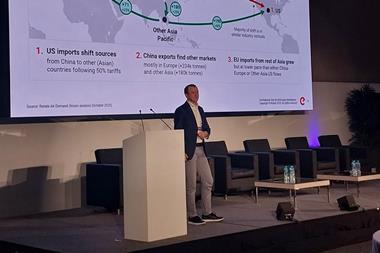
Speaking at TIACA’s Air Cargo Forum in Abu Dhabi this week, DSV vice president for airfreight commercial and sustainability Achim Martinka highlighted that IATA’s emissions calculation methodology differed for bellyhold and freighter aircraft.
Martinka told session moderator Emma Murray of Meantime Communications that for certain routes, there is a “huge difference” in the calculation, even when the same aircraft is being used.
”If you think about us as logistics service providers, consulting our customers, we would need to tell all our customers to avoid bellies in passenger aircraft wherever possible,” he explained.
”This would lead to a higher demand for freighter aircraft. So from a sustainability perspective, this is completely nonsense.”
He added that there was no reason for airlines to push for change because ”90% of the airlines are passenger driven” and the current method improves emissions performance for passenger operations.
”And the freighter guys, they are of course happy because they are calculated pretty well,” he said. ”At the end, as much as I understand the motivation to not really change something here, if we are really serious about sustainability, we need to change that.
“That needs the willingness of IATA and other associations and other industry initiatives. We need to think about it so that it is at least calculated exactly the same way as on passenger and freighter aircraft because then I can avoid consulting my customers to change [to freighters], because that doesn’t make any sense.”
IATA changed its emissions calculation for passenger aircraft in 2022, increasing the amount attributed to belly cargo in relation to the amount attributed to passengers.
As well as increasing the difference with freighters, it also meant the IATA calculation differed from that of the UN’s International Civil Aviation Organization (ICAO).
At the time, IATA said that the change would simplify the calculation and the previous method relies on outdated data and can result in variations. It said it had consulted with freight forwarders during the process.
Meanwhile, airlines on the panel said they were also reviewing the calculation.
Helene Goury, sustainability manager at Air France KLM Martinair Cargo (AFKLMP), said: ”At AFKLMP, we are also part of different initiatives to re-evaluate the calculation and make it more fair for freighters compared to belly freight.
”One of the barriers is to make sure we measure the same way based on the data, because a lot of the decisions are being made on data, and if the data is not right, how can we make the right decision. This is the challenge we are trying to solve.”
Noora Al Sharhan, head of environment, social and governance, Etihad Airways, added: ”We have been discussing this with IATA for a couple of months now and this is what we are trying to figure out.
”The calculations are different so how can we bring this together. We need to work with the industry and IATA and understand how we can identify things together.”