
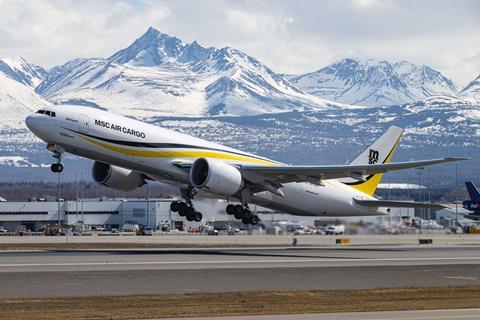
MSC Air Cargo has joined Germany-based airline association Barig as the group continues its drive to reduce the cost of airfreight operations in the country.
MSC Air Cargo chief executive Jannie Davel stressed the importance of Germany as an airfreight market in a press release sent out by the association to announce the addition of the airline.
“With the third highest gross domestic product in the world, Germany is an important business location,” he said. ”Therefore, it is important for us as a Barig member to be even more closely connected within Germany’s air cargo industry.
“We look forward to the constructive exchange and project development in the community.”
Meanwhile, Michael Hoppe, Barig chairman and executive director, stressed the importance of the expansion of its airfreight membership as it continues its campaign to reduce the cost and bureaucracy of cargo operations in Germany.
Barig recently warned that the country risked losing its status as an important airfreight location unless action was taken.
"We are delighted that MSC Air Cargo joins our Barig community and brings a high level of expertise in the airfreight sector,” Hoppe said.
"The industry in Germany has been facing numerous challenges, such as high location costs, complex processes, and a high level of bureaucracy.
"With the practical knowledge of our more than 30 international cargo airlines, we are committed to achieving measurable relief, accelerating processes, and improving the overall framework conditions for air freight in Germany.”
In May, Barig and German Aviation Association (BDL) called for the cost of cargo operations to be lowered and the removal of bureaucracy in order to secure the competitiveness of Germany as an airfreight location.
The associations said that the airfreight market was suffering from deteriorating conditions and to help alleviate pressure, they had co-written a white paper with five key demands.
The five demands include:
1. Reduction of state location costs: This involves the abolition of the national quota to include 0.5% of synthetic fuel in 2026, rising to 1% in 2028 and 2% by 2030. To help reduce costs further, a significant reduction in the costs for aviation security, infrastructure, air traffic control, and sustainable fuels, as well as a competition-neutral revision of the EU climate protection package, “Fit for 55.”
2. Uniform implementation of EU standards for aviation security: Barig would like to see EU standards applied in a practical manner similar to that in other EU countries and to ensure the same level of security.
3. Operating hours at air cargo hubs in line with demand: The operating hours at German airports “must be secured” in the long term and “must not be further restricted”, the paper states.
4. Aligned implementation of EU customs standards: When it comes to customs processes, the clearance of goods within EU standards can be significantly simplified and accelerated through digitalisation and automation, Barig said.
5. Simplified collection of import VAT: Compared to many other countries, there is “still considerable potential here in Germany”. BARIG said: "To this end, the clearing model, which is already being used successfully in many places, must be introduced in Germany, as it significantly reduces import costs as well as the administrative burden”.