


Anna-Maria Kirchner.
Source: Finnair Cargo
Finnair Cargo’s take on the current air cargo market is that it is “stable and normal” but the year has not been without its challenges, according to the airline’s head of global cargo sales, Anna-Maria Kirchner.
Speaking to Air Cargo News, Kirchner says the fact that the airline has a selective portfolio of destinations and doesn’t have any freighter aircraft has protected it from the ups and downs of this year’s cargo market.
“I have to say things are very stable and normal,” says Kirchner. “We do not see any dips in demand and yields; the flows have stayed the same, especially from Asia to the US or Asia to Europe, so we do not see any changes.”
She adds that the airline is in regular contact with customers and they are also “quite calm” about demand levels.
However, the year has not been without its challenges for the airline.
Towards the end of last year, its pilots began taking industrial action as their collective agreement was about to expire and negotiations with the airline over a new deal were taking time.
In the end, the pilots agreed to call a halt to the industrial action in May and a tentative agreement was reached in June.
The airline has also had to contend with industrial action from ground staff at Helsinki airport on several occasions this year, although an agreement covering this dispute has also now been reached.
In total, during the first half of the year, the airline had to cancel more than 2,300 flights due to the industrial action.
As a result, cargo tonnages at the airline in the first half were down 7.2%, although cargo revenues improved by 3.8% thanks to higher yields.
Another challenge faced by the airline over recent years is the inability to fly over Russia due to airspace bans as a result of the Ukraine war.
The airline had always been proud that it was able to offer the fastest route from Europe to Asia due to Helsinki’s location, but lead times have now been extended as flights route over the North Pole instead of Russia.
Kirchner says the carrier has made the best of the situation.
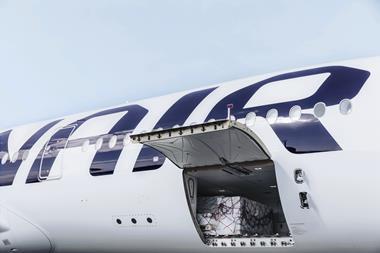
She points out that firstly, the airline’s A350 aircraft have had their maximum takeoff weight upgraded following modification work.
This gives the aircraft 8-12 tonnes more uplift and means that capacity is largely unchanged despite the extra fuel now needed to fly to Asia.
“Even going to Japan, which is 2.5 hours - 3 hours longer, and coming back as well, we have the same tonnage as flying over the Russian airspace,” explains Kirchner.
With a full passenger load, the A350s can “easily take a 20-tonne load” coming back from Japan.
She adds that the airline has also made other adjustments to its network as a result of the airspace ban and the delivery of new A350 aircraft.
“We are still very big going into Asia, but of course, we are going westbound a little bit more with the added capacity,” she says.
She adds: “We have doubled our capacity into the US now, so we are going up to 11 times per week into Dallas, which is our biggest destination this summer.
“Also, this summer, Chicago is now a daily flight; we fly five times per week into Seattle and daily into New York JFK, so we have added a lot of capacity into the US and also added a lot of capacity into Japan.”
Kirchner says Finnair now offers a daily flight to Haneda, Narita and Osaka and operates four times per week to Nagoya, where it is the only European airline to fly.
Partnerships on the rise
On the topic of network expansion, Kirchner says that its partnerships with other airlines also play a key role in expanding the airline’s reach.
She says that at the recent Air Cargo Europe event, she spent much of her time meeting with airlines to examine ways the airline could expand its partnerships and create new synergies.
She says that this drive to expand partnerships is part of a wider trend in air cargo.
“We are known for quality and a premium product, but we are also trying to build more partnerships.
“On the passenger side, there is a lot done with alliances and codeshares… on the cargo side, it is coming a little bit more, but that is something that Finnair is actively working on to see how we can maximise synergies.”

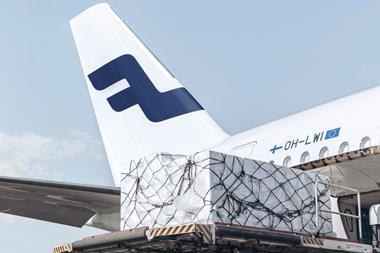
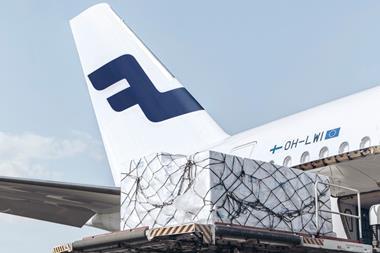
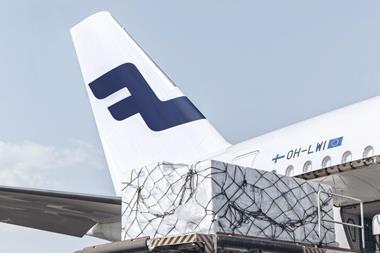
Finnair Cargo A350. Image Source: Finnair
Asked if there are any particular areas where the airline would like to expand its cargo business through partnerships, Kirchner says its services mainly cover the northern hemisphere, so South America and Africa are important areas for the future.
Kirchner identifies a few different reasons behind the recent focus on cargo partnerships: technology, larger customer demands for global operations, sustainability, a change in attitude to partnerships since Covid and people joining cargo from the passenger side of the business.
“Customers were not always too keen on interline, but it is not the same as it was 10 years ago because a lot of digitalisation has happened.
“We are not there just yet, but there are platforms now where you can complete interline bookings, so things that are normal on the passenger side, to book on one carrier and then have a leg flown by someone else, is coming in air cargo.
“It is great to see that digitalisation is helping air cargo to take the next step to tackle that.”
Green focus
Partnerships can also make airline operations more efficient and help reduce emissions generated by flying, an important focus area for Finnair.
Kirchner says that Finnair Cargo has a sustainability officer, while the overall airline has a whole team working on the topic.
The airline has a sustainable aviation fuel (SAF) programme in place and a deal with Finland-based SAF producer Neste.
“We have had road shows around the world where we have partnered with Neste to tell our customers what SAF is, how they can reduce emissions and to explain carbon emissions reporting.”
Earlier this year, Finnair and DB Schenker signed an agreement for DB Schenker to purchase nearly 400 tons of scope 3 CO2e reductions, equalling approximately 120 tons of SAF from Finnair.
Kircher points out that zero emissions targets mean sustainability is becoming an increasingly important topic for the aviation industry.
She points out that it is now mandated that 2% of fuel for flights originating from European airports needs to be SAF. This will increase to 6% in 2030, while oneworld alliance carriers have a 30% target for the end of the decade.
She says that the mandates differ from country to country, which could be seen as unfair, but increasingly, forwarders are asking for solutions to emissions reduction.
“Even in countries where there is no mandate, customers are saying I want this because they have their own targets,” she says.
“It’s in most of the tenders, so no one can just close their eyes. The price is still very high because the process of generating SAF is very complex and because there is not enough feedstock.
“But of course, it’s my own personal opinion, the more you sell, the better price you can get.”