





Mark Drusch, Qatar Airways Cargo’s chief officer cargo. Photo: Qatar Airways
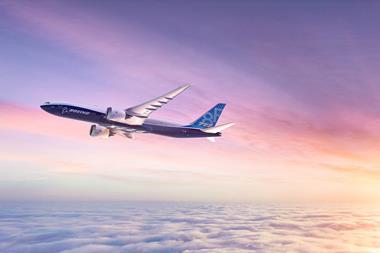
One of the main reasons for Qatar Airways’ recent deal for converted Boeing 777 aircraft was delays to the delivery of the new 777-8F aircraft that the airline has on order.
In 2022, the airline placed an order for 34 of Boeing’s new 777-8F jet, with options for 16 more. However, the launch date for the new widebody freighter has been pushed back from 2027 to 2028 at the earliest.
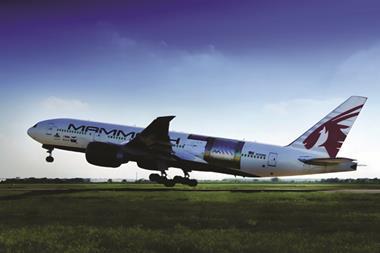
Qatar Airways chief officer cargo Mark Drusch told Air Cargo News the delay is one of the major reasons the carrier struck a deal with Mammoth Freighters for five converted 777-200LR freighters earlier this year.
”We were expecting to take the 777 -8Fs sooner than we are going to get them,” said Drusch. ”So that’s the first thing. Also, the availability of the factory 777Fs is limited, so we had this opportunity and took it.
”The conversions perform almost exactly like the factory aircraft. It’s amazing. That is the guarantee we have.”
He added: ”If it is hard to get more production aircraft and we can convert them at a very attractive capital expenditure and with the same performance, or only a marginally different performance, it is a no-brainer to give us capacity.”
Drusch said the first of the converted freighters is due to be delivered this year.
Earlier this year, the prototype 777 conversion, registered as N705DN, took to the skies following conversion at Mammoth’s modification partner facility, Aspire MRO, in Fort Worth, Texas.
Currently, Mammoth has seven 777-200/-300 aircraft undergoing conversion: five at Aspire MRO in Fort Worth, Texas, and two at STS Aviation Services in Manchester, UK.
Brian McCarthy, vice president of marketing and sales at Mammoth, told Air Cargo News in May that the first two 777-200LRFs will be for Qatar, with the next going to DHL.
While work continues on converting the aircraft, the company will also be attempting to gain STC approval for the conversion programme from US authorities.
In May, McCarthy said that smoke tests - where the smoke alarm systems are put through their paces - were about to be carried out, and then the process would be handed over to the Federal Aviation Administration (FAA) for STC approval.
Increased network flexibility
Meanwhile, Drusch also said that the current unpredictable market conditions meant it was increasingly important to be flexible with the airline’s freighter fleet.
”You need to be agile, you need to respond quickly,” said Drusch. ”So, what we have changed is how quickly we look at moving the network; every three or four days, if we need to, based on what’s going on in the market.
“It is in the best interest of all of us for us to put capacity where it is needed and take it out where it isn’t.”
He added that the situation has calmed down in recent weeks and now changes are more likely to take place every fortnightly, rather than every few days at the height of the tariff announcements.
However, Drusch also said it was important to maintain its network and the changes related to frequencies, rather than closing markets.
”We have had to take some capacity out of certain parts of Asia and we put capacity into the transatlantic, we put capacity into Africa, we put capacity into the Indian subcontinent, so we haven’t pulled any markets at all, we are just moving n+1 frequency because there isn’t as much demand. We haven’t shut anything down.”
He added that, in fact, the airline had expanded its network with a new call at Erbil.
”So where we have trimmed, nobody has lost, and where we have added, it is because there has been more demand.”