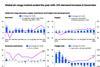





Cargo tonne-kilometers climbed 5.5% year on year, driven by emerging market strength and peak season activity despite continued weakness
Global air cargo demand was uneven in November, but there was strong growth in certain regions and peak season shipping helped bolster overall improvements.
Total demand, measured in cargo tonne-kilometers (CTK), rose by 5.5% compared to November 2024 levels.
"Global air cargo demand in November 2025 remained uneven but showed pockets of robust growth," said IATA. The trade body added: "Overall, the pattern highlights a market driven by strong emerging regional demand and selective Middle Eastern growth, with traditional large markets in the Americas showing continued softness."
Africa maintained double-digit momentum, climbing 15.6% year on year, while Asia Pacific saw 10.3% growth, driven by e-commerce growth and strong intra-regional trade flows, noted IATA.
Middle Eastern carriers also recorded solid performance, with cargo volumes up 7.4%, reflecting continued demand along Europe-Asia trade lane.
European airlines maintained steady momentum, expanding cargo by 5.8%, supported by strengthened shipments with Asia and North America.
Capacity, measured in available cargo tonne-kilometers (ACTK), increased by 4.7% year on year, supporting a Cargo Load Factor (CLF) of 49.1%, up 0.4 percentage points from November 2024.
"The capacity expansion accommodated rising demand while reflecting strategic fleet deployments across major markets," commented IATA.
However, jet fuel prices recorded a third consecutive monthly gain, rising 5.9% year on year. In this context, cargo yields continued to ease over the past seven months, with rates down 2.9% year on year
That said, month-on-month yields climbed 8.2%, marking the strongest single-month increment since December 2021, buoyed by peak-season demand.
IATA also pointed out that the global goods trade grew by 3.2% year on year in October and global manufacturing sentiment strengthened in November, with the PMI rising for the fourth consecutive month to reach 51.17.
New export orders improved slightly to 49.87, but remained below the 50-point expansion threshold, reflecting ongoing caution amid tariff uncertainty.
“Air cargo demand grew 5.5% year-on-year in November 2025, boosted by shippers prioritising timely delivery in the lead-up to the year-end holiday season," said Willie Walsh, IATA’s director general.
"Strong emerging market demand and selective Middle Eastern growth more than made-up for softness in the Americas amid ongoing adjustment to the new US tariff regime.
"Globally, the fourth quarter for air cargo was resilient as strategic re-routing of trade shaped performance across key markets. The strong end for 2025 bodes well for the air cargo industry as it enters the new year."
Regional performance in more detail
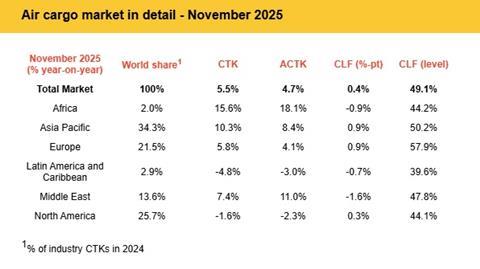
Asia-Pacific airlines saw a 10.3% year-on-year growth in air cargo demand in November. Capacity increased by 8.4% year on year.
North American carriers saw a 1.6% decrease in growth. Capacity decreased by 2.3%.
European carriers saw a 5.8% increase. Capacity increased 4.1%.
Middle Eastern carriers saw a 7.4% increase. Capacity increased by 11.
Latin American and Caribbean carriers saw a 4.8% decrease, the weakest performance of all regions. Capacity decreased by 3%.
African airlines saw a 15.6% increase, the strongest rise of all regions. Capacity increased by 18.1%.
Airfreight volumes in November 2025 increased across all major trade corridors.
IATA said in December that air cargo volumes in 2026 are expected to increase 2.4% year on year.
Figures from data provider Xeneta show that air cargo demand increased by 6% year on year in December and was up by 4% for the year overall, but the air cargo market may face some tough challenges this year as e-commerce volumes look set to come under further pressure.