




IATA data reveals continued market resilience despite Asia-North America route declines and a strong intra-Asia and Asia-Europe performance

Image source: Shutterstock
Air cargo demand improved for the seventh month in a row in September despite continuing traffic declines on the Asia-North America trade lane.
The latest figures from IATA show that air cargo demand in cargo tonne km (CTK) terms increased 2.9% year on year in September, while capacity in available CTK was up by 3% and the cargo load factor was flat on a year earlier at 45.7%.
While demand was up, the growth rate slowed from August's 4.1% increase and lags behind the 3.2% improvement registered over the first nine months.
"This result, however, does not offset the resilient performance of the market seen in recent months, which has benefited from a modal shift and front-loading," IATA said.
"This result demonstrates resilience, especially considering the suspension of small parcel shipping to the US by most postal services worldwide as they adjust to the end of the de minimis exception."
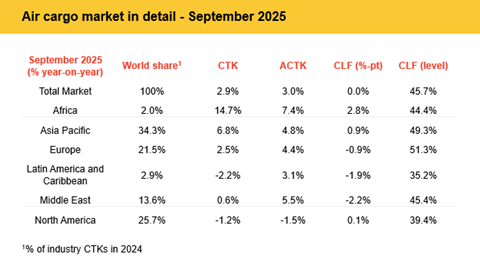
Asia Pacific airlines registered a 6.8% year-on-year increase, North American carriers registered a 1.2% decline, there was a 2.5% increase for European carriers, Middle Eastern airlines were up 0.6%, Latin American carriers were down 2.2% and African airlines improved by 14.7%.
While demand has continued to increase, there has been a shift away from the Asia-North America trade lane as a result of US tariff policy.
IATA director general Willie Walsh said: “Air cargo demand grew 2.9% year-on-year in September, marking the seventh consecutive month of overall growth. Buried in that growth is a significant alteration of trade patterns as US tariff policies, including the ending of de minimis exemptions, kick in.
"On one side of the equation, a decline in North America-Asia demand has set in over the last five months. But this has been more than compensated for with strong growth within Asia and on routes linking Asia to Europe, Africa and the Middle East.
"While many had feared an unwinding of global trade, we are instead seeing air cargo adapting successfully to serve shifting market demands.”
Trade lane figures demonstrate the shift away from the transpacific.
Asia-North America demand was down 3.5% on last year in September, IATA figures show, while Asia-Europe was up 12.4%, within Asia increased by 10% and Africa-Asia improved by 9.6%.
There were also increases on Middle East–Asia, North America-Europe, while declines were recorded on Middle East-Europe and within Europe.
Looking at trade indicators, IATA said that global goods trade grew by 3.7% year on year in August and global manufacturing sentiment strengthened in September, with the PMI rising for the second straight month to reach 51.3.
New export orders improved slightly to 49.6 but remained below the 50-point expansion threshold, "reflecting ongoing caution amid tariff uncertainty".
Elsewhere, jet fuel prices rose 5.4% in September despite lower oil prices, driven by a tighter diesel market.