
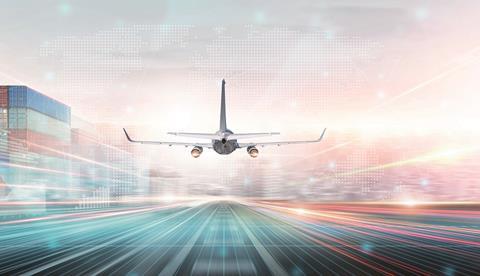
The outlook for air cargo over the coming months is uncertain, with a dynamic trade environment making it difficult to predict market developments.
In a market update, freight forwarder DSV identified two key challenges for the air cargo market: The ending of the US de minimis exemption for China and increased ocean freight capacity via the Suez Canal.
DSV explained that as a result of the ending of the de minimis exemption, e-commerce supply chains between China/Hong Kong and the US are shifting from a business-to-consumer model to business-to-business-to-cosumer setup, with companies now utilising warehousing to store inventory rather than shipping direct to the consumer.
This is reducing the need to use air cargo as shipments can now be moved by ocean.
“Given the size of the US market, his shift will have a global impact on airfreight capacity across multiple trade routes,” the company said.
Meanwhile, the gradual shift of ocean shipping back to the Suez Canal route is resulting in commodities from the Indian subcontinent and Southeast Asia moving back to ocean due to improved transit times and lower costs.
On the other hand, US tariff policy is resulting in diversified sourcing strategies as companies look beyond China to locations such as Vietnam, Thailand and the Indian subcontinent.
Meanwhile, there is also a boom in shipments of AI-related products and high-value tech shipments such as data racks, hard drives and computer chips.
“These high-value, time-sensitive commodities are primarily sourced from Southeast Asia and Taiwan, reinforcing increased airfreight demand from these regions,” DSV said.
DSV air and sea president for the US, Mads Ravn, also outlined several different developments that could impact how air cargo progresses over the coming months.
He said that the implementation of tariffs by the US on several major trading partners could lead businesses to explore alternative trade routes or sourcing strategies, while others may turn to airfreight to bypass bottlenecks and meet urgent delivery needs.
“These shifts could drive short-term volatility, with potential surges in air cargo traffic as companies adjust to new trade dynamics,” he said.
However, he added that the extent to which tariffs impact airfreight demand will depend on manufacturers’ and retailers’ responses.
“Higher import costs may reduce overall shipment volumes as companies seek cost-saving alternatives like nearshoring or ocean freight.
“Alternatively, persistent supply chain disruptions could boost air cargo demand as businesses prioritise speed and flexibility.”
Ravn said that if there are demand surges, this could put pressure on air cargo capacity.
”Industries such as high-tech pharmaceuticals and automotive may see increased airfreight reliance to mitigate tariff-related delays, further straining an already limited air cargo capacity and driving up freight rates and competition for space. With airfreight capacity already tight, any tariff-driven demand surge could exacerbate constraints.
“Conversely, if tariffs slow global trade, air cargo carriers may face lower demand, prompting adjustments in fleet utilisation and route planning.”