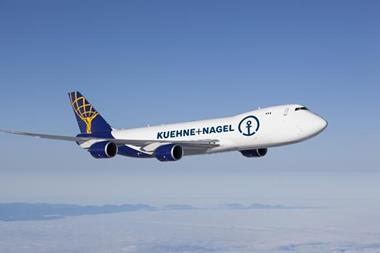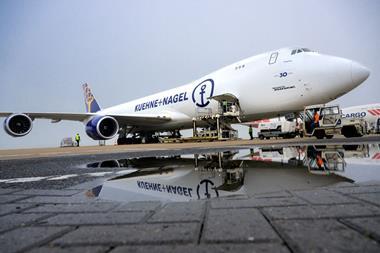


Kuehne+Nagel (K+N) is continuing to experience strong airfreight bookings despite the US-China tariff war.
Speaking following the announcement of the forwarder’s second-quarter results, Stefan Paul, chief executive of K+N International, said that airfreight was “continuously strong in terms of bookings”.
This is in contrast to seafreight, which has seen bookings out of China decline by around 25-30%, although much of that has been made up for by growing demand out of Southeast Asia.
"It might even be that the second quarter [for airfreight] will be stronger than the first quarter in terms of the volumes,” Paul said.
"To sum it up, flattish volumes in seafreight, very good trend in airfreight continues with a high demand in the marketplace.”
Smartphones, routers, chipmaking equipment and certain computers and laptops are currently exempt from the US 145% tariff rate on Chinese imports, although they do still face a previously announced 20% rate.
On airfreight yields, Paul said the outlook was less certain. He later explained that the US decision to end the de minimis exemption for packages from China could drive down e-commerce volumes and result in spare capacity in the market, which would in turn drive down rates.
Paul was also asked how different customer segments were responding to the tariffs. He said there was no set pattern, with differing strategies depending on the vertical.
He said high-tech and semiconductor segments were stable, industrial was a mixed picture, automotive continued to struggle and large consumer shippers had “stopped or paused their bookings to a certain degree”.
K+N’s airfreight business had a positive start to the year, with semiconductors and perishables leading the improvements.
Air turnover improved by 13% year on year to Sfr1.8bn, earnings before interest and tax (ebit) was up 23% to Sfr116m and airfreight volumes improved by 5% to 514,000 tonnes.
The forwarder said improvements were led by its semiconductor and perishable business, as well as its investment in China-based Apex Logistics.
Meanwhile, automotive was a drag on performance.
”Excluding the automotive sector, the business unit gained market share across all industries and particularly in semiconductors,” K+N said in a press release. “New cool corridors for healthcare were opened between Brussels and Chicago as well as between Brussels and Singapore.”