



Freighter operators redeploy aircraft to Asia-Europe lanes as transpacific capacity contracts, with bellyhold growth offsetting modest gains
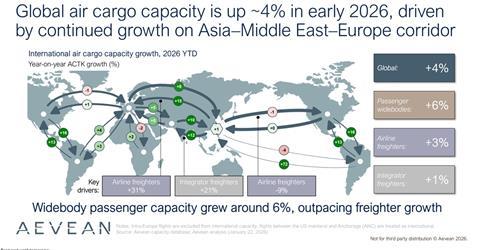
Air cargo capacity has increased compared with a year ago in the opening weeks of the year, while freighter operators continue to shift capacity away from the transpacific market.
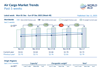
Data from analyst and consultant Aevean show that global air cargo capacity rose by 4% year on year between 1 January and 22 January.
The analysis indicates that airlines are further reducing their exposure to the transpacific trade, with the strongest capacity growth concentrated on Asia–Europe and Asia–Middle East routes, as well as services linking North and South America.
Capacity between Asia and Europe increased by 15% compared with a year earlier, while Asia–Middle East capacity rose by 12%. On the Americas lanes, cargo capacity from North America to South America climbed by 16%, with a 13% increase in the opposite direction.
By contrast, capacity on the Asia–North America route — the world’s largest air cargo trade lane — declined by 1%.
A breakdown of capacity sources shows that bellyhold space rose by 6% year on year, while freighter operators expanded capacity by 3% and integrators by 1%.
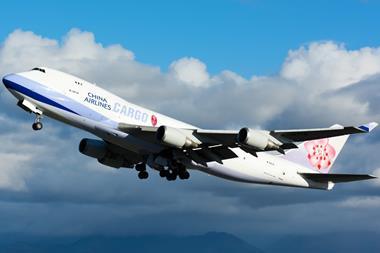
The data also highlight a pronounced redeployment of freighter aircraft away from the transpacific. Freighter capacity from Asia to North America fell by 9%, while capacity from Asia to Europe surged by 31%.
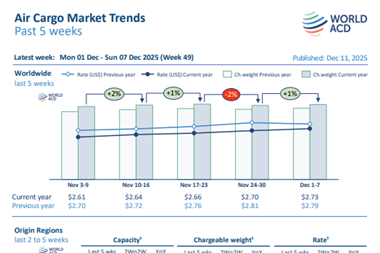
The overall 4% increase in capacity broadly aligns with early-year demand trends. Figures released earlier this week by WorldACD show that air cargo demand rose by 5% year on year in the first full week of January.
The capacity outlook is under close scrutiny following warnings from IATA late last year that cargo space could tighten during 2026.
Julia Seiermann, IATA’s head of industry analysis, said the ongoing global aircraft shortage weighed on the cargo sector last year and is expected to persist.
She cited data showing that the global aircraft order backlog now exceeds 17,000 aircraft, equivalent to nearly 60% of the active fleet and 11 times the number of aircraft delivered annually.