


After a strong performance over the first 10 months of the year, the air cargo market is showing signs of slowing down now the peak season is underway

DSV is expecting a slower than usual peak season but remains positive for 2026 as the airfreight industry benefits from supply chain shifts.
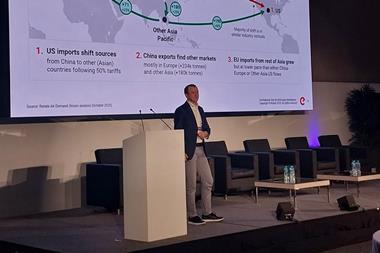
Speaking at this week’s TIACA Air Cargo Forum in Abu Dhabi, Stefan Krikken, DSV vice president, airfreight, told session moderator Glyn Hughes that 2025 had so far been a positive period for air cargo, which has now recorded 26 consecutive months of growth.
However, recent weeks had seen performance weaken compared with the rest of the year, he said.
And although Krikken remained positive about the trade outlook for 2026, he said growth would be "a bit more muted" and air cargo performance would be driven by shifting trade patterns.
"We are seeing it slow down a little bit," said Krikken. "It is now November and we should normally see a very strong peak, but the peak is relatively slow this year."
"Having said that, there is still a lot of positive momentum in airfreight when it comes to trends in relation to cloud computing, e-commerce and also when it comes to trade shifts," he said.
"Flexibility and agility are more key than ever. You have to be very agile as a freight forwarder right now when it comes to wars, to trade, when it comes to sourcing patterns that are shifting to Southeast Asia, so I think this year, and also into 2026, I think it is still a positive market, but you have to be very agile."
He added that with GDP growth forecast at 3% next year, there was still a chance that air cargo could record a new record for consecutive months of improvement.
On the supply front, Krikken said that he expected limited capacity over the coming five years and this had been one of the reasons the forwarder had been expanding its own airfreight capacity through a partnership with Atlas Air as well as through its acquisition of Schenker, which had its own airfreight operation.
He added that it had opted for a wet lease setup for its partnership with Atlas because this allowed for greater flexibility - something he said was essential in today's unpredictable market.
Meanwhile, Krikken also provided an update on DSV's integration of Schenker, which he said was progressing "ahead of schedule".
He said that every month DSV was integrating new countries into its setup and by the end of the first quarter, it hopes that 80% of the business "will be live".
He added that further acquisitions could be on the cards for the forwarder.
"DSV has been shown to be very good at integrations, so we are going to continue to acquire companies," he said. "Even now, with the Schenker volumes, the market share is still quite limited - our industry is good for consolidation."